Deadline
Applications should be sent by email to [email protected] by midnight UK time on 24 July. Only short-listed candidates will be contacted for interview.
Interviews will be conducted on a rolling basis and ALNAP may recruit for this position before the deadline.
Background
Since 2001, ALNAP has been publishing 'Learning from crises' papers (formerly known as lessons papers) with the aim of improving humanitarian action by synthesising and presenting lessons from previous responses in a concise, readable, actionable and timely manner. The last comprehensive ALNAP 'Learning from crises' paper on floods was published in July 2014. Since then, there have been numerous crises linked to floods, and new lessons and insights have emerged. In 2018, ALNAP developed a methods note to improve and guide the quality of lesson papers by reducing the space for author bias, improving the grounding of evidence and enhancing transparency of the methods used. This method was further developed in 2021. We are now looking to revise the 2014 floods paper to bring it up to date with the latest learning and apply more rigorous methods in line with the methodology revisions.
About the assignment
ALNAP is looking to contract a team of researchers to conduct research to identify learning from responses to floods, in accordance with ALNAP’s methodology for ‘learning from crisis’ papers. The researchers are expected to produce one long form, comprehensive paper detailing the relevant lessons.
Aim and Scope
The purpose of the ‘Learning from crises’ paper is not to provide a definitive answer on ‘what works’ but rather to highlight critical issues that humanitarian agencies must consider when designing and implementing response programmes in a flood-affected area. The research will aim to identify lessons that are applicable at different stages of flood response:
- Diagnostics: useful lessons for decision-makers ahead of an expected flood, including monitoring, assessing needs, data collection and early warning.
- Response: useful lessons for decision makers designing and implementing a flood response, including early/anticipatory action, effective response modalities, and cross-cutting themes.
- Recovery and resilience: useful lessons for decision makers looking at integrating recovery and resilience activities and preparedness for the next flood into the response.
As the paper is focused on response to floods, the lessons learned should be specifically related to flood response as opposed to other types of crisis response. However, recognising that flood crises often occurs in conjunction with other severe pressures (climate crisis, extreme poverty, etc.), the paper should consider nuances in context and types of floods.
The research will draw from various sources, including a review of evaluations and other types of learning reviews (grey literature), and academic literature. The research will use the 2014 flood paper as one source of literature, capturing learning prior to 2015. The rest of the source material will be publications from 2015 onwards, in order to capture more recent learning.
Target audience
The primary audience for this paper is humanitarian ‘implementers’ - particularly agency and NGO staff (including country leads and technical leads) who design and implement responses to floods. The secondary audience is humanitarian policymakers and funders who can help the primary audience make changes to the shape of a response.
The humanitarian sector is increasingly grappling with the limits of its mandate and its ability to secure funding. Therefore, the sector is calling for increased investment by development actors to tackle chronic needs among marginalised communities and those in fragile settings.1 As such, the paper will also seek to highlight what learning could be relevant to development- or dual-mandate actors, where possible.
Research questions
The main research question is as follows:
What can be learned for humanitarian implementers from evaluations, documented research and expert opinion on responses to floods globally?
The following sub-questions have been identified:
- Diagnostics:
- What learning has emerged on the effective use of early warning systems for response preparedness and mitigation of severe impacts of flood? What were the challenges and opportunities?
- Early/anticipatory action and response:
- What learning has emerged on the effective application of early/anticipatory action?
- What forms of relief are the most effective for saving lives and alleviating suffering at the various stages of flood response? What makes them successful/less successful?
- Are there any useful lessons specific to flood response on any of the following cross-cutting issues:
- Localisation/locally-led action
- AAP
- Protection
- Gender and inclusion
- Recovery and resilience:
- How can humanitarian response support the resilience of communities and reduce vulnerability to future flood episodes?
- What learning has emerged on effective approaches to DRR and floods?
- How is climate change expected to affect floods and thus impact current learning about the effectiveness of flood responses?
The main research question and sub-questions will be explored and further developed in the inception report. The research questions can be adjusted if necessary.
Timeline
The contract will span between July 2026 and March 2027. Please note that the timeline is preliminary and subject to change. The total number of work days for this assignment is 60 days to be distributed among the different team members.
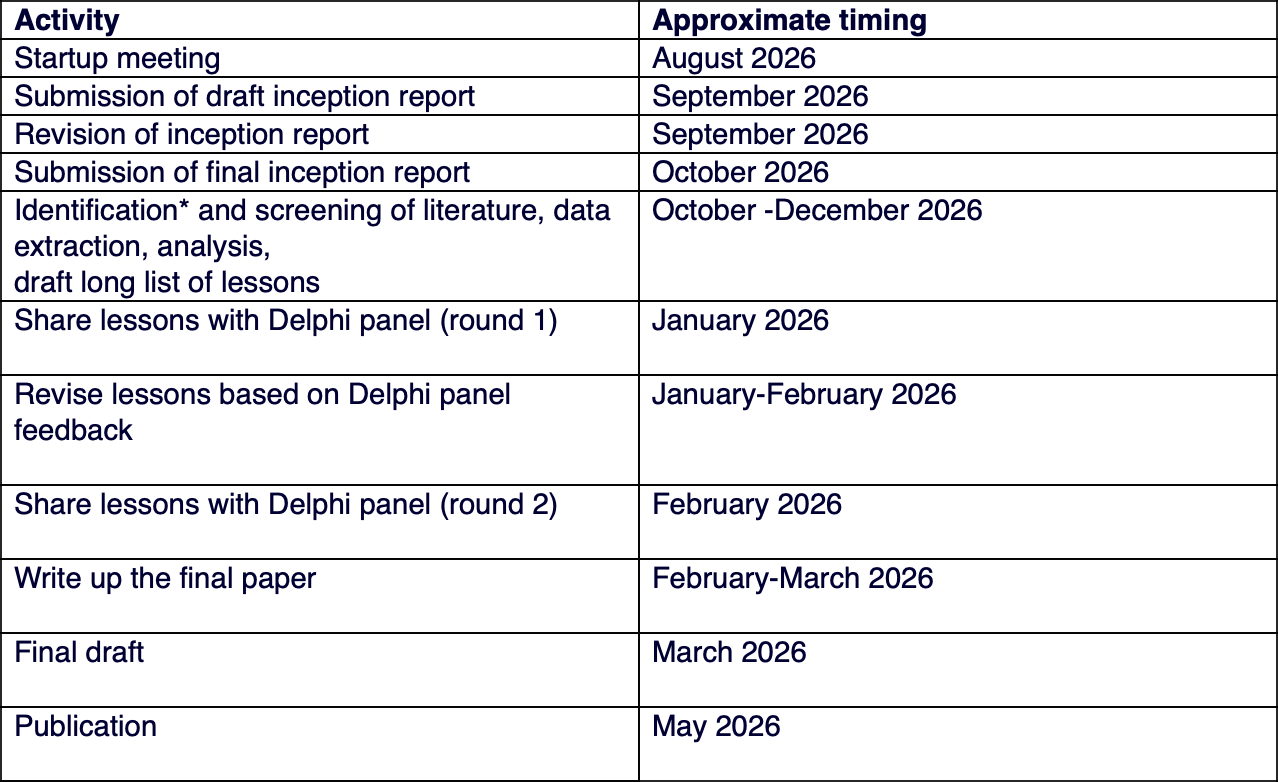
Some resources have been pre-identified, and these will be shared with the researchers.
Qualifications
Required
- Experience conducting research in humanitarian contexts.
- At least 1 member of the team has a demonstrated track record in evaluation synthesis or a closely related type of product, i.e. systematic review, evidence synthesis.
- All members of the team have a demonstrated track record in timely delivery of high-quality analysis and writing, verifiable through referees.
- Successful experience working as a remote team.
- Proven track record of delivering large, complex projects to deadline.
- Proven track record of conducting research collaboratively.
- Able to write, in English, in a clear and consistent style, adhering to the agreed document length.
Desired
- Prior experience using MaxQDA or similar software to code transcripts/documents as part of a research project.
We are particularly interested in applications from researchers with lived experience of countries affected by crisis.
Application process
Candidates are expected to submit the following documents:
- CVs outlining relevant experience of all team members (each CV shall not exceed 4 pages)
- A brief proposal (max 3 pages) which outlines how you would approach the work and describing the composition and location of the proposed research team, as well as previous experience in conducting similar work. Proposals should indicate whether these relationships are pre-existing or new for this proposal and should indicate who will act as the ‘lead’ researcher.
- Estimates of days & budget for each activity/deliverable
- Two references for the lead researcher from professional assignments undertaken in the last 5 years. The assignments must be thematically relevant to the scope of work of this assignment.
Interviews will be conducted on a rolling basis and ALNAP may recruit for this position before the deadline.