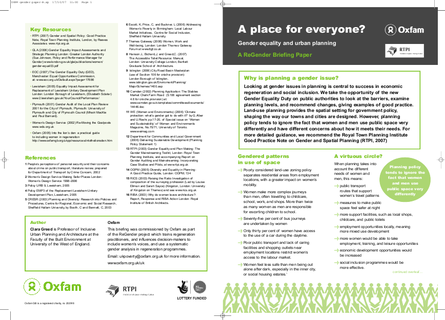
Looking at gender issues in planning is central to success in economic regeneration and social inclusion. We take the opportunity of the new Gender Equality Duty on public authorities to look at the barriers, examine planning levels, and recommend changes, giving examples of good practice. Land-use planning provides the spatial setting for government policy, shaping the way our towns and cities are designed. However, planning policy tends to ignore the fact that women and men use public space very differently and have different concerns about how it meets their needs. For more detailed guidance, we recommend the Royal Town Planning Institute Good Practice Note on Gender and Spatial Planning (RTPI, 2007)
Resource collections
- Accountability to affected populations (AAP)
- UN Habitat - Urban Response Collection
- Urban Response - Urban Crisis Preparedness and Risk Reduction
- Urban Response Collection - Community Engagement and Social Cohesion
- Urban Response Collection - Economic Recovery
- Urban Response Collection - Environment and Climate Change
- Urban Response Collection - Housing, Land and Property
- Urban Response Collection - Urban Crisis Response, Recovery and Reconstruction
- Urban Response Collection - Urban Resilience