Listening to children and responding to their feedback during Save the Children's humanitarian response in Myanmar
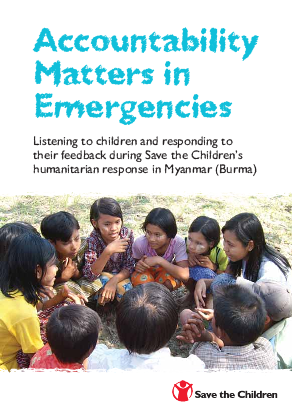
How can we make ourselves more accountable to the children and communities we work with and for, and maximise the quality and impact of what we do when we respond to humanitarian disasters through our emergency programming? What tools work well in different situations, and in different cultural contexts? What are we trying to achieve by making ourselves, as an organisation, more accountable, not just upwards (to donors) but downwards, to the people we’re trying to get aid to (project beneficiaries)? Where do we start? This case study was written to share our experience of setting up information centres in Myanmar (Burma) after Cyclone Nargis struck in May 2008. We wanted to capture the lessons learned, and share practical suggestions with other programme staff and practitioners. Here, we describe what we did, how we did it, and some of the key considerations involved. We also describe what we achieved, and the lessons we learned through our accountability self-assessment. We piloted a number of approaches to making our emergency response more accountable and, ultimately, more effective. First, we set up information centres linked to food distribution points. Then, we set up an information centre that worked closely with peer educators, who used creative ways of promoting children’s participation and finding out their views. Based on our experience with these two pilots, we developed a ‘general information centre’ model. The idea was that children and adults in a given village (whether individuals or representatives from other organisations) could give us feedback about any of our activities, across all sectors: education, child protection, health, nutrition, livelihoods, and disaster risk reduction. We also developed a clear procedure for handling complaints from project beneficiaries. We hope this case study answers some of the key questions about how we become a more accountable organisation. We also hope it inspires others to find the best ways of improving their accountability to children and their communities, whatever the context.