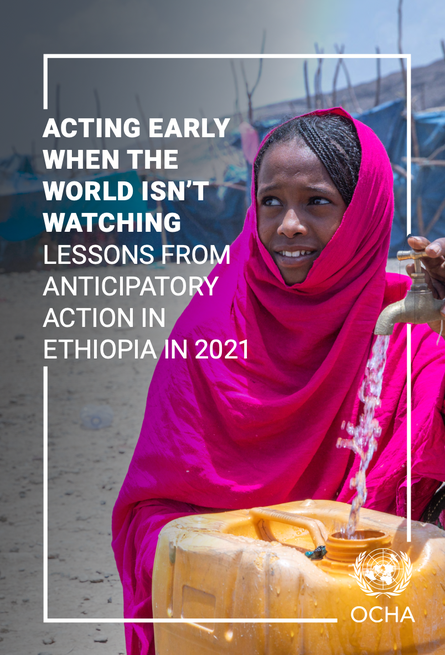
When a country is hit by a sudden disaster – an earthquake, a tsunami or floods – the impact is immediate, the crisis makes headlines and aid often follows. But when a country is hit by a slow-moving disaster, such as a drought, it can take months or even years to see the devastating impact. These crises unfold in slow motion: crops fail, livestock die, people sell their assets and leave their homes, women and girls risk their safety as they walk further to find water, and children are pulled from school.
Droughts are predictable, but they too often fail to receive funding until suffering reaches catastrophic levels and dramatic images hit the media. This has been Ethiopia’s experience, time and time again. Between October 2020 and June 2022, Ethiopia experienced five consecutive below-average rainy seasons, with the 2022 March-May season being the driest in 70 years. The drought’s prolonged nature ultimately affected an estimated 17 million people.
But this time there was a glimmer of hope. The humanitarian community acted earlier thanks to the UN Office for the Coordination of Humanitarian Affairs (OCHA) piloting an anticipatory action framework. In December 2020 – earlier than any other donor – OCHA’s Central Emergency Response Fund (CERF) provided US$20 million to humanitarian partners to reduce the drought’s impact on more than 900,000 people.
According to a satisfaction survey carried out by 60_decibels, more than 60 per cent of the recipients of assistance reported improvements in their overall quality of life. The pilot framework also taught valuable lessons in what anticipatory action means in a prolonged and complex crisis. As Joyce Msuya, the Assistant Secretary-General for Humanitarian Affairs and Deputy Emergency Relief Coordinator, concluded: “In 2024, drought is once again driving millions of people to suffer. The Ethiopia anticipatory action pilot demonstrated that if we act earlier, people’s lives will be better. We have the evidence, now we must scale.”
Highlights
- For Ethiopia, living with climate volatility requires anticipating droughts and floods and mitigating their impact on the most vulnerable people.
- In 2020, OCHA facilitated an anticipatory action framework in Ethiopia to get ahead of droughts and reduce their impact on vulnerable communities.
- OCHA activated the pilot framework in December 2020, while political and humanitarian focus was on the Tigray conflict in Ethiopia.
- The Central Emergency Response Fund released US$20 million to reduce the drought’s impact on more than 900,000 people. The allocation was one of the earliest responses to the 2020-2022 drought.
- Three out of five recipients of assistance reported an improved ability to afford food, livelihood inputs and household bills.
- In a world where humanitarian crises compete for political attention and resources, Ethiopia proves that anticipatory action frameworks make acting early the default.
- The pilot taught valuable lessons in how to improve anticipatory action’s impact in the context of protracted and overlapping crises.