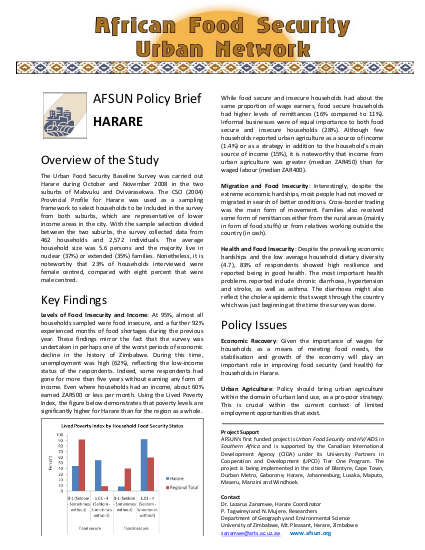
With an urban population approaching 40%, Zambia is one of the most urbanized countries in SADC. Lusaka, the capital city of Zambia, is urbanizing rapidly and accounts for approximately 32% of the country’s total urban population. The city has grown considerably since 2000 when the census recorded a population of just over one million. Most of this growth has been informal in character, posing significant problems of access to adequate social and physical services for an increasing proportion of urban citizens. Under these challenging conditions of urban growth and poor economic performance, poverty and associated food insecurity are important development challenges for Lusaka and Zambia as a whole. The Urban Food Security Baseline Survey was undertaken in the second half of 2008 to establish the levels of food insecurity amongst poor urban households in the city. Using a randomised approach, the survey deliberately drew its sample of 400 households and 1,978 individuals from lower socio-economic areas of the city. The findings show that the urban poor in Lusaka are facing dire circumstances of poverty and food and nutrition insecurity.The Urban Food Security Baseline Survey was carried out Harare during October and November 2008 in the two suburbs of Mabvuku and Dvivarasekwa. The CSO (2004) Provincial Profile for Harare was used as a sampling framework to select households to be included in the survey from both suburbs, which are representative of lower income areas in the city. With the sample selection divided between the two suburbs, the survey collected data from 462 households and 2,572 individuals. The average household size was 5.6 persons and the majority live in nuclear (37%) or extended (35%) families. Nonetheless, it is noteworthy that 23% of households interviewed were female centred, compared with eight percent that were male centred.
Links
Resource collections
- Locally led humanitarian action
- UN Habitat - Urban Response Collection
- Urban Response - Urban Crisis Preparedness and Risk Reduction
- Urban Response Collection - Community Engagement and Social Cohesion
- Urban Response Collection - Economic Recovery
- Urban Response Collection - Environment and Climate Change
- Urban Response Collection - Housing, Land and Property
- Urban Response Collection - Urban Crisis Response, Recovery and Reconstruction
- Urban Response Collection - Urban Resilience