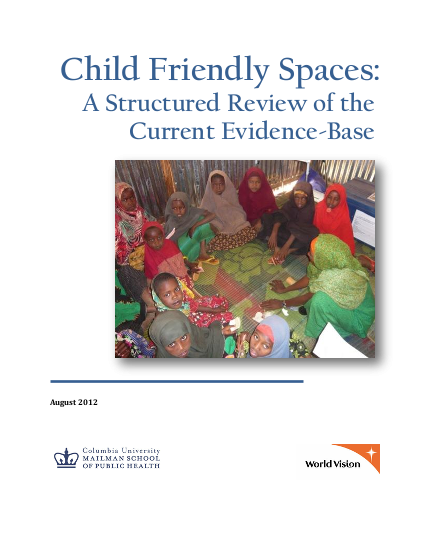
Child Friendly Spaces (CFSs) are a widely used tool to help support and protect children in the context of emergencies. Sometimes called Safe Spaces, Child Centered Spaces and Emergency Spaces for Children, CFSs are used by a growing number of agencies as a mechanism of protecting children from risk, as a means of promoting children’s psychosocial well-being, and as a foundation for strengthening capacities for community child protection capacity.
All ten studies documented reports of positive outcomes of CFS, particularly with respect to psychosocial well-being. However, major weaknesses in design constrain the ability to robustly confirm change over time (only three studies reported pre-intervention baselines) or attribute any such change to CFS intervention (only two studies utilized a comparison with communities not receiving CFS). Analysis suggests that: greater commitment to documentation and measurement of outcomes and impacts is required; more standardized and rigorous measurement of processes, outputs, outcomes and impacts is necessary; evaluation designs need to more robustly address assessment of outcomes without intervention; there is a need to sustain engagement of children within the context of evaluations; and long-term follow-up is critical to establishing evidence-driven interventions.