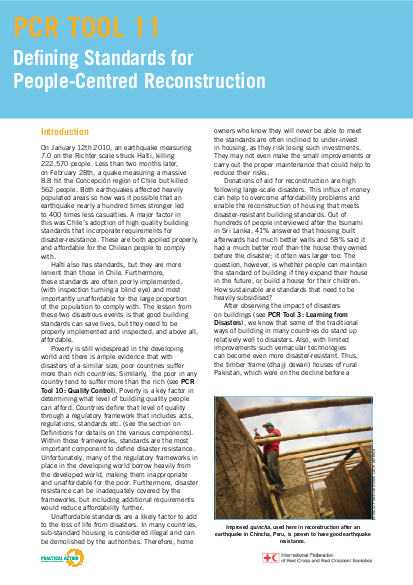
On January 12th 2010, an earthquake measuring 7.0 on the Richter scale struck Haïti, killing 222,570 people. Less than two months later, on February 28th, a quake measuring a massive 8.8 hit the Concepción region of Chile but killed 562 people. Both earthquakes affected heavily populated areas so how was it possible that an earthquake nearly a hundred times stronger led to 400 times less casualties. A major factor in this was Chile’s adoption of high quality building standards that incorporate requirements for disaster-resistance. These are both applied properly, and affordable for the Chilean people to comply with. Haïti also has standards, but they are more lenient than those in Chile. Furthermore, these standards are often poorly implemented, (with inspection turning a blind eye) and most importantly unaffordable for the large proportion of the population to comply with. The lesson from these two disastrous events is that good building standards can save lives, but they need to be properly implemented and inspected, and above all, affordable.
Resource collections
- Accountability to affected populations (AAP)
- ALNAP focus topics
- Evaluating humanitarian action
- UN Habitat - Urban Response Collection
- Urban Response - Urban Crisis Preparedness and Risk Reduction
- Urban Response Collection - Community Engagement and Social Cohesion
- Urban Response Collection - Economic Recovery
- Urban Response Collection - Environment and Climate Change
- Urban Response Collection - Housing, Land and Property
- Urban Response Collection - Urban Crisis Response, Recovery and Reconstruction
- Urban Response Collection - Urban Resilience