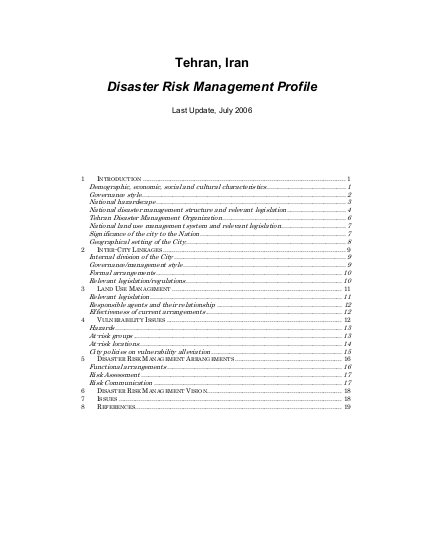
Iran, or Persia, as it was known until 1935, is located in South West Asia. Turkmenistan and the Caspian Sea, Afghanistan, Pakistan, the Persian Gulf, the Gulf of Oman, Iraq and Turkey bound the 1,648,000 sq km large country. Iran is one of the most arid regions of the world, and suffers frequent droughts, floods and landslides. In addition, due to its position in the Alpine-Himalayan mountain system, Iran is also subject to numerous and often severe earthquakes.
The total population of Iran is 68,017,860 (July 2005 est.), making it also, one of the most populous countries in the region. Persians make up over half of the population, while the Azerbaijani account for at least 25%. Other ethnic minorities include Kurds, Lors, Bakhtiaris, Baluchis, Arabs, Armenians, Assyrians and Jews. In addition to the local population, Iran has over the past two decades, hosted one of the largest refugee populations in the world. The estimated number of these refugees, mostly from war-torn Afghanistan and Iraq, has varied between two and four million.
Resource collections
- UN Habitat - Urban Response Collection
- Urban Response - Urban Crisis Preparedness and Risk Reduction
- Urban Response Collection - Community Engagement and Social Cohesion
- Urban Response Collection - Economic Recovery
- Urban Response Collection - Environment and Climate Change
- Urban Response Collection - Housing, Land and Property
- Urban Response Collection - Urban Crisis Response, Recovery and Reconstruction
- Urban Response Collection - Urban Resilience