Oxfam's DRR Strategy 2025, outlines the specific objective of strengthening local institutions, actors and communities' capacity to assess, understand, monitor, anticipate and manage disaster and conflict-related risks and prepare to respond, recover and 'build back better' from shocks.
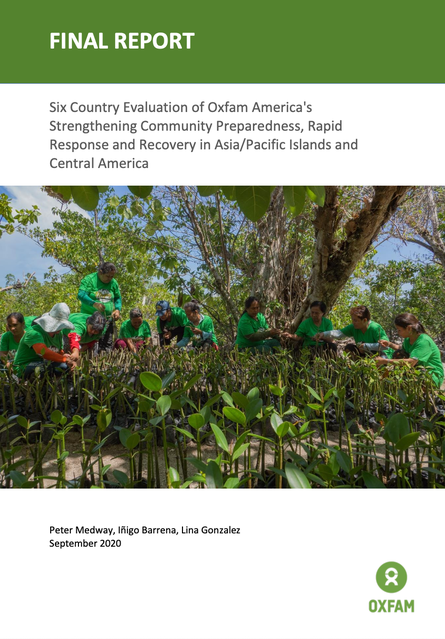
With that strategic aim as a reference, Oxfam America's program for "strengthening community preparedness, rapid response and recovery in Asia/Pacific Islands and Central America" was designed. The program comprised two regional programmes, each implemented in three countries. The programme expected to benefit 143,150 people directly or indirectly in the Asia/Pacific and 52,635 people in Central America. The program was made up of two distinct regional interventions: the Asia Pacific Local Innovation for Transformation (APLIFT) and the Acción Temprana Comunitaria Centro América (ATECA).
The programs shared a common goal to ensure that participating communities affected by recurrent natural disasters have enhanced capacities for disaster preparedness, response, and recovery and are better equipped to co-lead on relief and recovery efforts in collaboration with local authorities. This would consequently reduce vulnerability and suffering. The programmes also benefitted from an Emergency Response Fund (ERF) to provide up to three months of seed funding for immediate disaster response in the countries of operation, or the region. The program applied Feminist Principles through-out the planning and delivery of all its interventions.
This evaluation report addresses the two main evaluation questions: (i) what are the changes and learnings that have occurred in communities' disaster preparedness? and (ii) what contributed to the changes in communities' disaster preparedness? These two questions relate to OECD evaluation criteria for Impact, Relevance and Effectiveness. A light-touch contribution analysis to determine the degree to which the program was responsible for the impacts/changes observed in the community was also included in the evaluation terms of reference.