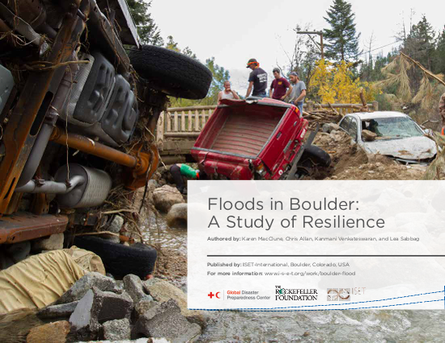
On September 9th, 2013 heavy rain started falling along the Front Range in Colorado. When the rains stopped five days later parts of Boulder County, which was hardest hit, had received nearly a year’s worth of rain. Rivers and creeks, swollen well beyond bank-full in many locations, had destroyed roads and bridges, torn out culverts and downed trees, flooded homes and businesses, and resulted in the evacuation of several towns. Boulder County and 14 surrounding counties were declared federal disaster areas. Statewide, over 18,000 people were evacuated, more than 1200 by helicopter.
Yet in spite of the destruction, a common refrain from residents and government officials alike was how lucky they had been. Though rivers peaked in the middle of the night, though the scale of the event was unprecedented, only 10 lives were lost, most systems were maintained, and the response and recovery have been strong, well-coordinated and effective.
What made the area resilient to the devastation? This study demonstrates that the following actions in three major categories increased resilience: physical systems, human systems, legal and cultural norms.
Links
Resource collections
- Floods
- Learning from crises (Natural hazards)
- UN Habitat - Urban Response Collection
- Urban Response - Urban Crisis Preparedness and Risk Reduction
- Urban Response Collection - Community Engagement and Social Cohesion
- Urban Response Collection - Economic Recovery
- Urban Response Collection - Environment and Climate Change
- Urban Response Collection - Housing, Land and Property
- Urban Response Collection - Urban Crisis Response, Recovery and Reconstruction
- Urban Response Collection - Urban Resilience