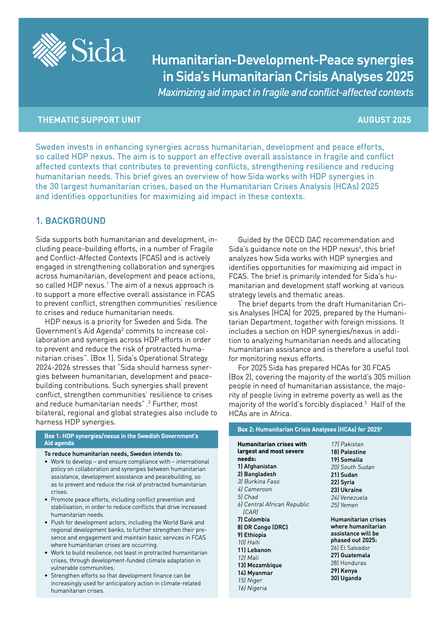
Sida supports both humanitarian and development, including peace-building efforts, in a number of Fragile and Conflict-Affected Contexts (FCAS) and is actively engaged in strengthening collaboration and synergies across humanitarian, development and peace actions, so called HDP nexus. The aim of a nexus approach is to support a more effective overall assistance in FCAS to prevent conflict, strengthen communities’ resilience to crises and reduce humanitarian needs. HDP nexus is a priority for Sweden and Sida. The Government’s Aid Agenda commits to increase collaboration and synergies across HDP efforts in order to prevent and reduce the risk of protracted humanitarian crises”.
Sida’s Operational Strategy 2024-2026 stresses that “Sida should harness synergies between humanitarian, development and peacebuilding contributions. Such synergies shall prevent conflict, strengthen communities’ resilience to crises and reduce humanitarian needs”. Further, most bilateral, regional and global strategies also include to harness HDP synergies.
Guided by the OECD DAC recommendation and Sida’s guidance note on the HDP nexus, this brief analyzes how Sida works with HDP synergies and identifies opportunities for maximizing aid impact in FCAS. The brief is primarily intended for Sida’s humanitarian and development staff working at various strategy levels and thematic areas. The brief departs from the draft Humanitarian Crisis Analyses (HCA) for 2025, prepared by the Humanitarian Department, together with foreign missions. It includes a section on HDP synergies/nexus in addition to analyzing humanitarian needs and allocating humanitarian assistance and is therefore a useful tool for monitoring nexus efforts. For 2025 Sida has prepared HCAs for 30 FCAS, covering the majority of the world’s 305 million people in need of humanitarian assistance, the majority of people living in extreme poverty as well as the majority of the world’s forcibly displaced. Half of the HCAs are in Africa.
The brief focuses on:
1) Nexus approaches: why and where.
2) HDP synergies in contexts with bilateral development strategies/regional country windows.
3) HDP synergies in contexts without bilateral strategies/regional country windows.