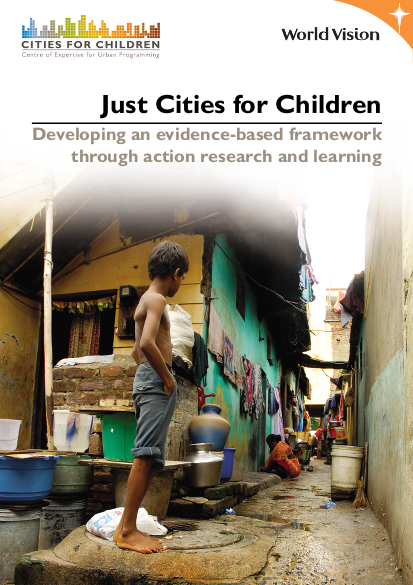
As is the case with almost all aid agencies, World Vision has traditionally worked with poor rural communities, focusing on children’s well-being through community-based Area Development Programmes. However, with more than one billion children (almost half the world’s children) now living in cities and urban areas, it is appropriate that the organisation turn its attention to the vulnerable children in cities. World Vision’s Centre of Expertise for Urban Programming (Urban CoE) was set up in 2010 to provide technical leadership on urban programming and drive an urban-poverty learning agenda within the organisation. In an effort to test the applicability of World Vision’s rural models to urban settings, and to discover emerging urban practices, six World Vision field offices were identified to launch urban pilot projects. These are Cambodia, Indonesia, India, South Africa, Lebanon and Bolivia. This report begins to formalise and share what World Vision has learned about working in urban settings, slums and informal settlements, comparing this emerging knowledge across diverse, dense, dynamic urban contexts to determine implications for programming impact and to generate insights into approaches to urban programming, funding and organisational adaptation.
Resource collections
- UN Habitat - Urban Response Collection
- Urban Response - Urban Crisis Preparedness and Risk Reduction
- Urban Response Collection - Community Engagement and Social Cohesion
- Urban Response Collection - Economic Recovery
- Urban Response Collection - Environment and Climate Change
- Urban Response Collection - Housing, Land and Property
- Urban Response Collection - Urban Crisis Response, Recovery and Reconstruction
- Urban Response Collection - Urban Resilience