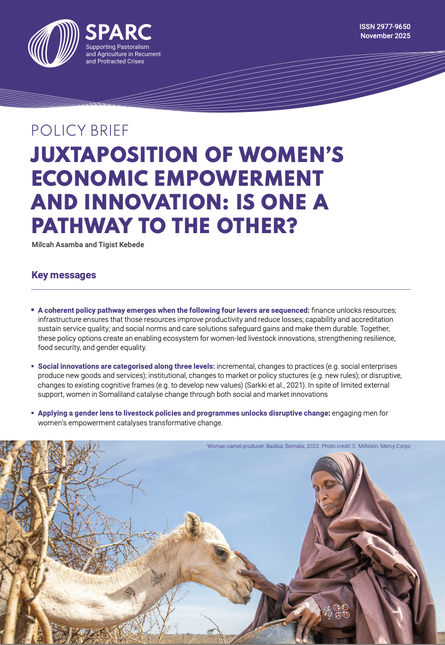
This report explores ways in which economically empowered pastoralist women initiate and or adopt innovations at a personal and communal level. In Somaliland, women’s work, often invisible, anchors herd management, processing, and local trade, yet is constrained by limited assets, restrictive social norms, and traditional household responsibilities such as caring for children, collecting water, cleaning, and preparing family meals.
Our objective was to explore the relationship between women’s empowerment and innovation. Specifically, we aimed to understand local definitions of women’s economic empowerment and innovation; to identify formal and informal innovations created or adopted by pastoralist women, especially during crises; to explore drivers of innovation and the strategies women use to advance economically; and to examine links between women-led innovation and empowerment at practical, institutional, and normative levels. Across villages in Hargeisa and Wajaale town, Somaliland, SPARC researchers conducted six focus group discussions (FGDs) with pastoralist and agro-pastoralist households.