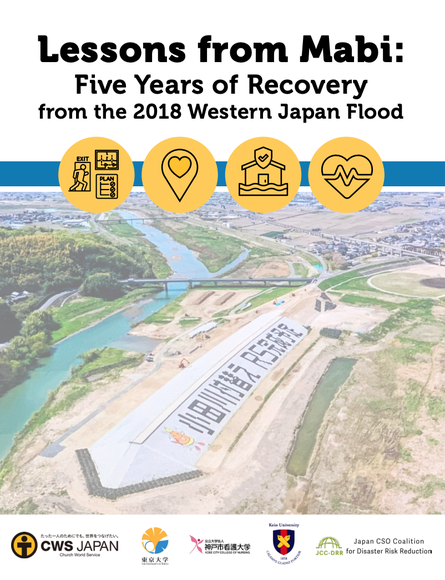
In early July 2018 , continuous heavy rains hit Western Japan, causing devastating flooding in many prefectures, including Hiroshima, Okayama, and Ehime. Mabi Town in Okayama Prefecture was one of the hardest hit areas, with two rivers, the Takahashi River and the Oda River , overflowing, inundating one -third of the town .
In addition to providing emergency assistance, CWS Japan published a report summarizing important lessons learned. The report, " Six Months since Western Japan Flood – Lessons from Mabi, " was published in January 2019 , approximately six months after the disaster , and extracted lessons learned in areas such as risk communication, early warning, infrastructure measures, evacuation behavior, shelters, and volunteer management. In July 2019, one year after the disaster, a second report , " Towards Mabi 's Recovery – Lessons One Year On, " was published, focusing primarily on the recovery process.
As July marks the fifth anniversary of the torrential rain disaster, CWS Japan revisited the affected areas and compiled lessons learned from the recovery process. This report aims to summarise the main lessons learned from the initial response to long-term recovery, and we hope that these lessons will be useful to stakeholders, experts, practitioners, and civil society around the world.
Resource collections
- ADRRN Knowledge Hub
- ALNAP focus topics
- Climate emergency
- Evaluating humanitarian action
- Floods
- Learning from crises (Natural hazards)
- Locally led humanitarian action
- Monitoring of humanitarian action
- Urban Response Collection - Environment and Climate Change
- Urban Response Collection - Urban Crisis Response, Recovery and Reconstruction