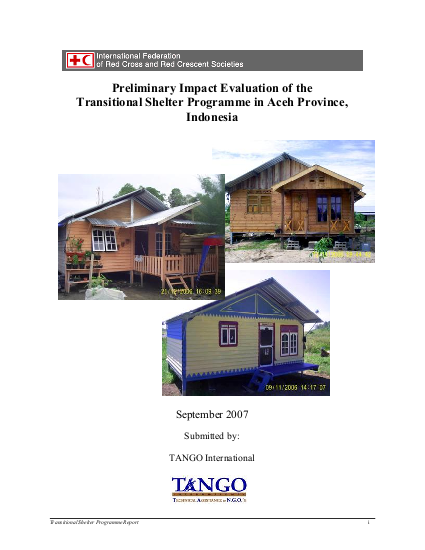
The International Federation of the Red Cross’s (IFRC) Transitional Shelter Programme (TSP) began in August 2005 in response to the need for temporary shelter among an estimated 67,000 individuals in Aceh and Nias whose homes were damaged or lost in the wake of the tsunami disaster of December 2004. From the outset, the programme was intended to benefit large numbers of displaced households living in inadequate shelter conditions who needed immediate, temporary housing assistance that would not compromise their ability to eventually relocate into permanent structures. At the time of the survey, 16,521 transitional shelters had been constructed in ten districts of Aceh Province and Nias by over thirty implementing partners, including PMI (Indonesian Red Cross) and the International Federation. The survey sought to: Ø Determine overall beneficiary satisfaction with the transitional shelter programme ; Ø Determine beneficiaries perceptions of future plans regarding permanent housing ; Ø Determine demographic profile of transitional shelter beneficiaries; and Ø Determine the level of access to essential support services (e.g. water, sanitation, healthcare, livelihoods etc.) A multi-stage sample design was used for the transitional shelter survey. The operational area was stratified into four zones, each zone representing a different region of Aceh province. Within each zone, a further stratification was done based on whether or not a site represented a return area (RA) or a transitional shelter site (TSS). The next stage of sampling was a clustering of households in each of the four zones and shelter area types (TSSs and RAs). A minimum of fourteen clusters (villages/sites) were selected with probability proportional to size for each zone and area type, except in Zone 4 (Simeulue) where only TSS sites were sampled. The final stage of the sampling process was a random selection of households. In each cluster a fixed number of households (14 for most clusters) was randomly selected from a sampling frame of transitional shelter households. A total of 220 households were selected for each strata. After data cleaning, a total of 1,561 households were available for analysis.