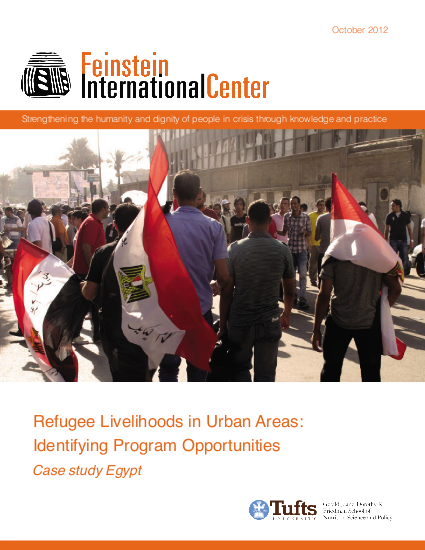
Refugees in urban areas face a specific set of livelihoods problems, and in recent years many aid agencies have begun to try to address these problems by supporting refugees through vocational training, microcredit and other services. So far, however, there has been little evidence about which humanitarian programs work, and where opportunities for programming interventions lie. This study, funded by the US State Department’s Bureau of Population, Refugees and Migration, addresses this knowledge gap. Through case studies in Cairo, Tel Aviv and Quito, we analyzed the urban livelihoods context for refugees and identified programming opportunities and promising program initiatives. In each city, we sought to generate new ideas from related fields of inquiry, such as low-income urban development and youth employment,that could be adapted for refugees in countries of first asylum.
Our three case studies represent contrasting refugee policy contexts and livelihoods experience, and offer lessons for other host settings. Each case study begins with a review of existing livelihood programs in the country. This includes a mapping of commercial, humanitarian and governmental organizations that provide programming, advocacy or other resources that support the livelihoods of refugees, migrants and low-income citizens. We then interviewed asylum seekers and key informants to deepen our understanding of the livelihoods context in each country. Our main program recommendations, based on all three cases, are included as a stand-alone document.
Links
Resource collections
- Accountability to affected populations (AAP)
- Evaluating humanitarian action
- Monitoring and Evaluation (M&E)
- Monitoring of humanitarian action
- UN Habitat - Urban Response Collection
- Urban Response - Urban Crisis Preparedness and Risk Reduction
- Urban Response Collection - Community Engagement and Social Cohesion
- Urban Response Collection - Economic Recovery
- Urban Response Collection - Environment and Climate Change
- Urban Response Collection - Housing, Land and Property
- Urban Response Collection - Urban Crisis Response, Recovery and Reconstruction
- Urban Response Collection - Urban Resilience
- Use of evaluation evidence