Mutual aid in time of crises Collection
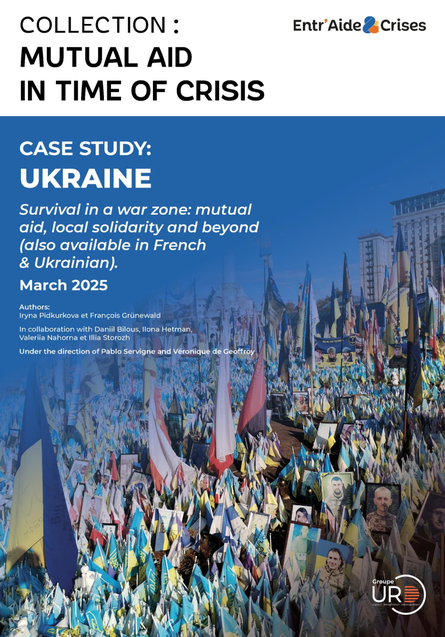
"Survival in a war zone: mutual aid, local solidarity and beyond": The large-scale invasion of Ukraine by the Russian Federation in February 2022 transformed Ukrainian society. The moral shock of aggression by a neighbouring state awoke emotions in Ukrainians that have been instrumental in building collective identity and cohesion. Traditional top-down models of humanitarian response are being replaced by strong horizontal relationships based on social solidarity and mutual aid. This report examines mutual aid mechanisms and proposes a series of recommendations to address certain challenges.
About the 'Mutual aid in time of crises’ Project
People who suffer disasters while unprepared and untrained to deal with them tend to cope by means of mutual aid and spontaneous, informal self-organisation. Aid and relief actors only rarely, however, avail themselves of this potential for working together. This contradiction underlies the project ‘Mutual aid in times of crisis’.
This operational research project is based on a series of case studies, enabling better understanding of the mutual aid processes that spontaneously emerge in times of crisis, and how these intersect with official aid.
The case studies were selected to illustrate different types of crisis (natural disaster, major inflow of migrants, conflict), analysing mutual aid strategies according to the type of crisis and the socio- political context.
Three case studies consider sites in France: the Roya Valley, which was struck by Storm Alex in 2020; the Briançon region where a crisis caused by migrants arriving over the border has intensified over the past several years; and the island of Réunion, which is regularly struck by cyclones. A further three case studies consider N’Djamena in Chad where there was severe flooding in 2022; the Greater Uki area in Australia which suffered from catastrophic fires in 2019 followed by floods in 2020; and finally, Kharkiv in Ukraine where people have been surviving and mobilising to help each other since war began in 2022.
The case studies contribute to the development of a knowledge base and operational recommendations for people and individuals involved in mutual aid as well as organisations working in the sector of emergency aid and relief.