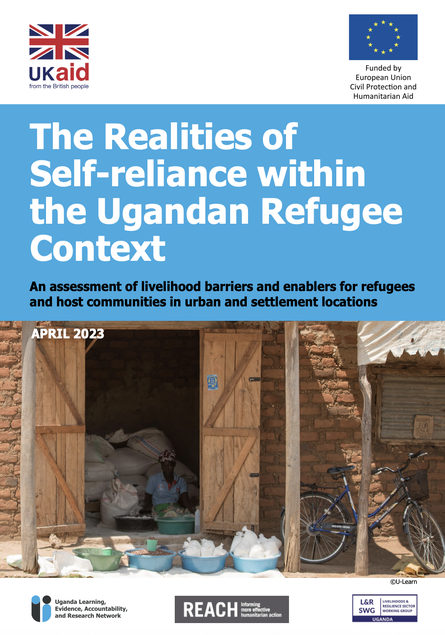
The refugee crisis in Uganda is becoming increasingly protracted. The country has a long history of hosting refugees, and continues to host around 1.5 million refugees today. Uganda’s progressive refugee policies have meant that refugees have been welcomed in settlements across the west and north of the country, and have freedom of movement and the right to work.
However, despite the progressive policies and numerous programmes geared towards supporting refugees and host communities, many households struggle to obtain self-reliance. In light of the persisting vulnerabilities and reductions in the humanitarian funding going to the country, it is important to generate a better understanding of how the livelihoods and resilience of refugee and host community households can be supported.
The main objective of the assessment presented here was to better understand the primary barriers to the sustainable livelihoods of refugees and host communities across urban and settlement contexts, in order to inform how the livelihoods of these groups can be best supported. The assessment covered refugees and host communities in four settlements (Bidibidi, Nakivale, Palabek, and Rhino Camp), four secondary urban centres (Arua, Gulu, Kitgum, and Mbarara), and Kampala.
Additional Downloads
Resource collections
- Accountability to affected populations (AAP)
- Evaluating humanitarian action
- IASC Collection - Inclusion
- Monitoring and Evaluation (M&E)
- Monitoring of humanitarian action
- UN Habitat - Urban Response Collection
- Urban Response - Urban Crisis Preparedness and Risk Reduction
- Urban Response Collection - Community Engagement and Social Cohesion
- Urban Response Collection - Economic Recovery
- Urban Response Collection - Environment and Climate Change
- Urban Response Collection - Housing, Land and Property
- Urban Response Collection - Urban Crisis Response, Recovery and Reconstruction
- Urban Response Collection - Urban Resilience
- Use of evaluation evidence