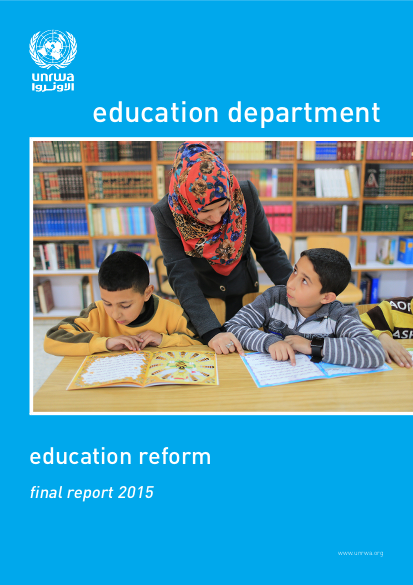
This is the final report of UNRWA Education Reform (2011-2015), as although work must continue to embed, sustain and build upon its achievements in the Medium Term Strategy (MTS) period, the funded implementation period of the Reform ended in December 2015. The Education Reform Strategy (ERS) was designed to bring about transformational change to classroom practices and thus improve children’s learning outcomes through the adoption of a systemic and interrelated approach. It was formally endorsed by the UNRWA Senior Management and the UNRWA Advisory Committee in 2011.
UNRWA operates 692 elementary and preparatory schools across its five fields of operations, as well as eight secondary schools in Lebanon, providing free basic education for around half a million Palestine refugee children. In addition, vocational training and higher education is provided at eight vocational training centres (VTCs) for 7,000 Palestine refugees in all fields, and for 2,100 students in two educational science faculties (ESFs) teacher training institutes in the West Bank and Jordan. Literacy rates among Palestine refugees compare well with regional and global levels. Additionally, gender equity in enrolment has been achieved since the 1960s.