This article was originally published in The Lancet
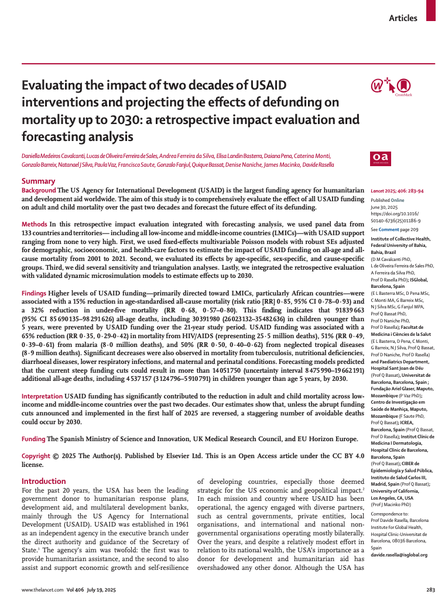
The US Agency for International Development (USAID) is the largest funding agency for humanitarian and development aid worldwide. The aim of this study is to comprehensively evaluate the effect of all USAID funding on adult and child mortality over the past two decades and forecast the future effect of its defunding.
In this retrospective impact evaluation integrated with forecasting analysis, the authors used panel data from 133 countries and territories— including all low-income and middle-income countries (LMICs)—with USAID support ranging from none to very high. First, fixed-effects multivariable Poisson models with robust SEs adjusted for demographic, socioeconomic, and health-care factors were used to estimate the impact of USAID funding on all-age and allcause mortality from 2001 to 2021. Second, the authors evaluated its effects by age-specific, sex-specific, and cause-specific groups. Third, several sensitivity and triangulation analyses were conducted. Lastly, the authors integrated the retrospective evaluation with validated dynamic microsimulation models to estimate effects up to 2030.
Key findings
USAID funding has significantly contributed to the reduction in adult and child mortality across lowincome and middle-income countries over the past two decades. Our estimates show that, unless the abrupt funding cuts announced and implemented in the first half of 2025 are reversed, a staggering number of avoidable deaths could occur by 2030.