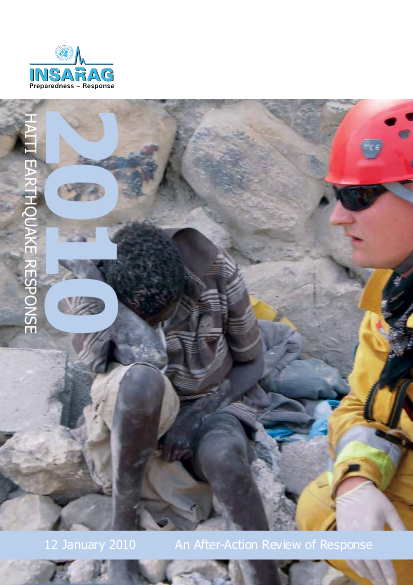
As the humanitarian coordination body of the United Nations, the mandate of Office for the Coordination of Humanitarian Affairs is to ensure efficient and coordinated response to emergencies. This mandate requires coordination amongst all the humanitarian actors, especially at the very first phase of an emergency. As one of OCHA’s primary partners in the critical life-saving phase of emergency response, the International Search and Rescue Advisory Group was once again at the forefront of the international rescue and relief operations following the devastating earthquake which struck Haiti on 12 January 2010. OCHA - as the provider of the INSARAG Secretariat and custodian of many of the international community’s first response tools, such as the Global Disaster Alert and Coordination System (GDACS), the Virtual On-Site Operations Coordination Centre and the United Nations Disaster Assessment & Coordination (UNDAC) team - worked around the clock to facilitate information sharing amongst all responders. OCHA immediately deployed a team of UNDAC members – many travelling to the disaster site with international urban search and rescue (USAR) teams - to support operational coordination of USAR teams on the ground throughout the rescue phase and to jumpstart OCHA’s humanitarian coordination activities of the international humanitarian response. The INSARAG network grew out of lessons learned from earthquake response. The 1988 Armenia Earthquake was the trigger for its creation. International urban search and rescue teams rushed to assist the country in its rescue efforts, but there was no communication, no system of coordination. Teams worked wherever they found a need, rather than be directed to where there were priority requirements for the kinds of technical expertise and equipment they possessed. Recognising that this was not an effective way to respond, INSARAG was created in 1991, to set up a system of operational coordination, to foster minimum standards, to work to common methodology and guidelines. The work of INSARAG and its methodology was endorsed by the United Nations General Assembly Resolution 57/150 of 2002 on “Strengthening the Effectiveness and Coordination of International Urban Search and Rescue Assistance”. First on the ground, USAR teams work hand-in-hand with local response teams, bringing additional expertise and technology to assist where needed, where local resources may be lacking. In addition to search and rescue support, INSARAG USAR teams provide medical support and are often providers of the first assessments, the first information to come out of a disaster site, the first indication of needs and priorities. This information is shared with the international community, through the Virtual OSOCC and on the ground, to assist planning and targeting of international humanitarian relief efforts. When the rescue phase draws to a close, INSARAG teams move to recovery activities, helping extract bodies for burial – so important to families and loved ones – rubble removal, structural evaluations, always in support of local teams, always in coordination with other response efforts. INSARAG has always collectively evaluated its response, recognising the importance of sharing experience to bring improvements to the INSARAG Guidelines and methodology. Thus, the Haiti Earthquake After-Action Review Meeting took place in Switzerland on 02-03 June 2010, hosted by the Swiss Government. This publication is an example of how INSARAG methodology is taken forward as a living process, summarizing the many recommendations to come out of the USAR community’s experiences in Haiti with the aim of enhancing the quality of collapsed structure disaster response.
Resource collections
- Earthquakes
- Learning from crises (Natural hazards)
- UN Habitat - Urban Response Collection
- Urban Response - Urban Crisis Preparedness and Risk Reduction
- Urban Response Collection - Community Engagement and Social Cohesion
- Urban Response Collection - Economic Recovery
- Urban Response Collection - Environment and Climate Change
- Urban Response Collection - Housing, Land and Property
- Urban Response Collection - Urban Crisis Response, Recovery and Reconstruction
- Urban Response Collection - Urban Resilience