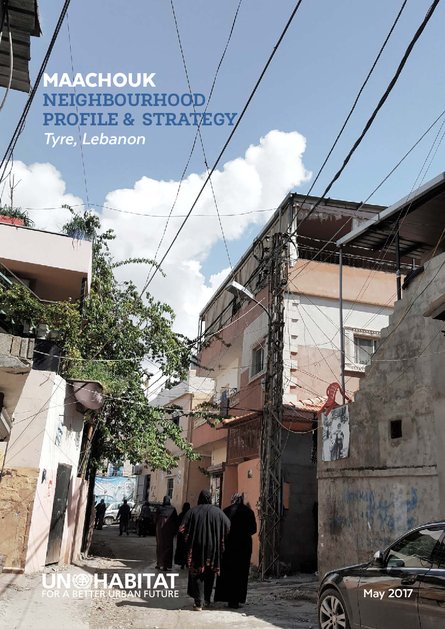
The selection process of Maachouk neighbourhood was jointly conducted by local authorities, local community representatives, and UN-Habitat Lebanon. The selection criteria was: an impotent neighbourhood characterized by a poor socio-economic status, high refugee influx, and a deficient basic urban services rank. Boundary verification was carried out through a participatory approach using community-based knowledge, (I)NGOs experience, and municipal expertise. Maachouk is a multinational residential neighbourhood that falls mostly within the boundaries of Sour Municipality. The formation of the settlement dates back to the early years following the Palestinian refugee influx (1948-1952), when Palestinians reached Maachouk and settled on public lands. Today, the neighbourhood accommodates diverse nationalities including Palestinians, Lebanese and Syrian refugees. Labour on a daily-basis constitutes the main source of income for inhabitants followed by agriculture. Maachouk comprises one to three-story residential buildings made of concrete with substandard construction methods and bad foundations.
Resource collections
- UN Habitat - Urban Response Collection
- Urban Response - Urban Crisis Preparedness and Risk Reduction
- Urban Response Collection - Community Engagement and Social Cohesion
- Urban Response Collection - Economic Recovery
- Urban Response Collection - Environment and Climate Change
- Urban Response Collection - Housing, Land and Property
- Urban Response Collection - Urban Crisis Response, Recovery and Reconstruction
- Urban Response Collection - Urban Resilience