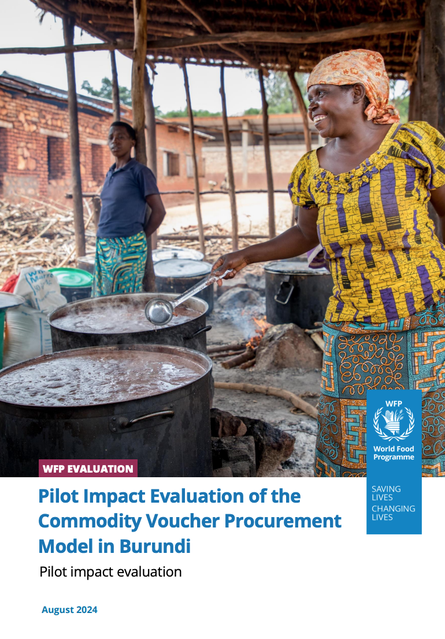
In 2022-2023, WFP worked with partners to test a new commodity voucher procurement model for the school feeding programme in three provinces in Burundi.
A pilot impact evaluation was conducted as a lean impact evaluation to assess whether this commodity voucher model improves school meal quantity, diversity, and quality compared to the centralized in-kind model. This pilot impact evaluation also supports the feasibility assessment and development of a larger scale impact evaluation on school feeding in Burundi.
This pilot impact evaluation tested a decentralized Commodity Voucher (CV) procurement model for school feeding in Burundi, comparing it to the existing centralized model. The intervention enabled provincial education offices to procure food directly from local farmer cooperatives. Results show that the CV model significantly increased the number of school feeding days per month (13 vs. 7.4) but slightly decreased meal quality due to increased use of refined rice over fortified maize. The CV model was also more cost-efficient. The pilot confirms the feasibility of a larger-scale impact evaluation to assess long-term effects on child nutrition and local economies.