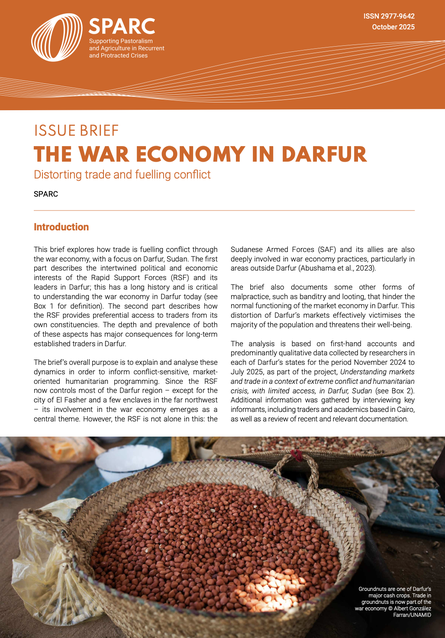
This brief explores how trade fuels conflict through the war economy in Darfur and highlights consequences for established traders, with the aim of informing market-oriented humanitarian programming.
The Rapid Support Forces (RSF) now control most of the Darfur region. The political and economic interests of the RSF and its leaders have, for a long time, been closely intertwined. Even more so since civil war broke out in April 2023 and the RSF gained unfettered access to some of the most lucrative forms of trade and business in Darfur, and thus to the exploitation of resources.
Analysing and understanding these interests is key to understanding the war economy in Darfur, and essential for humanitarian policy-makers and practitioners to ensure their actions do not inadvertently fuel the war economy. The purpose of the brief is to gain a deeper understanding of the links between trade and the war economy in Darfur. Furthermore, it aims to provide analysis of how the RSF gives preferential access to traders from its own constituencies, which results in negative consequences for many long-term established traders.