Comprehensive report on a multi-phased learning activity
Developing durable solutions that enable displacement-affected communities (DACs) in Somalia to better support themselves requires:
- Insights into the lives, livelihoods, and market and rural networks of women DACs—who, along with their children, are at the center of the current displacement crisis; and
- A better understanding of market and non-market connections and flows between rural areas in Southwest State and urban Baidoa Town, including Barwaqo resettlement site. This rural-urban chain and the surrounding context together comprise the rural-urban system.
This report represents the culmination of one of the most extensive community engagement processes conducted in Somalia to date: a six-month research and human-centered design activity that explored these topics through in-depth, exploratory, and participatory mixed-methods research and a three-day co-creation workshop. The activity involved 39 women DAC members of self-help groups (SHGs), 16 of their trade linkages, and 18 key informants from government, financial service providers, training organizations, trade associations, and non-governmental organizations (NGOs).
Women DACs Nearly all of the women DAC SHG members who participated in the activity have lived in Baidoa Town for several years and benefitted from multiple layers of durable solutions and livelihoods programming. Originally, over one-third lived in nearby rural areas within Baidoa District and most others came from elsewhere within Bay or Bakool Regions. Still, women DACs retain strong personal and market connections with their rural origins, facilitated by mobile phones, mobile money, land ownership, and transporters and are inhibited by insecurity, poor road quality, long distances, and costs of mobile airtime and charging.
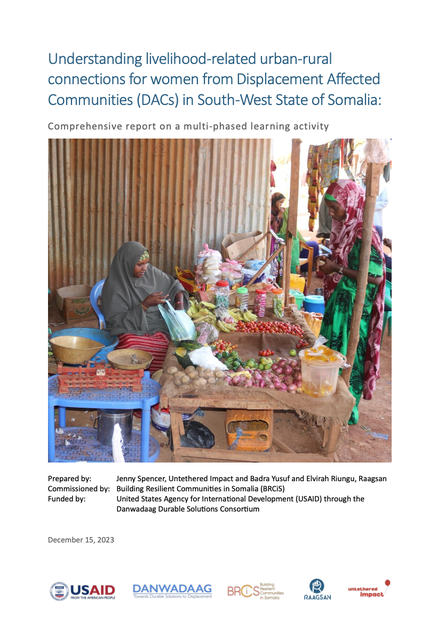
While few women DACs have even basic literacy—a major barrier—most participants have used tiny capital investments from family or NGOs to enter into trade-based livelihoods selling goods like vegetables, cereals, milk, and firewood and/or imported goods such as rice, sugar, oil, and clothing, mostly procured from retailers and wholesalers in town. Some have built thriving shops thanks to grants from NGOs and support from their SHGs, but others are at risk of losing their businesses, which have been kept alive during the drought thanks to humanitarian cash assistance provided to their customers. Other risks are ever-present, as demonstrated when flash flooding just prior to the co-design workshop washed away the household and business assets of several participants.
Although some formal financial services targeted to their demographics exist, the use of informal trade credit is common, and all of the women are SHG members, limited access to start-up capital, loans, and skills inhibits them from scaling up their businesses and consistently earning sufficient incomes. Indeed, only two-thirds earn enough to meet their families’ basic needs, a concern that is always at the front of their minds. In addition to being the primary breadwinners, women DACs remain the caretakers of their children, around whom their lives revolve and whose well-being informs most of their decisions. Their main accomplishments include providing safety and food for their children, owning their land or homes, and saving.