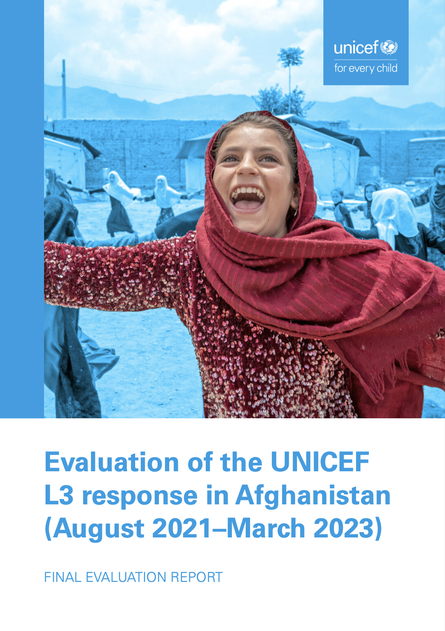
This evaluation examines UNICEF’s Level 3 response to the humanitarian emergency in Afghanistan, which lasted between September 2021 and June 2023. The evaluation covers the period from August 2021, when the Taliban seized power, to March 2023.
The arrival of the Taliban in power added considerable complexity to a protracted humanitarian situation in which humanitarian needs were acute among the majority of the population, and conditions for programme delivery highly challenging. In the days and weeks that followed this event, a plausible and widely held assumption was that systems of governance and basic service provision would collapse, and expose an already highly vulnerable population to further risk and hardship.
The L3 Corporate Emergency activated by UNICEF on 8 September 2021 provided the basis for an operational ramp-up whose intended scale was without precedent in the agency’s history. In its Humanitarian Action for Children (HAC) planning document released for Afghanistan in December 2021, UNICEF set its 2022 target for programme coverage at 15.3 million people, including 8.1 million children, and its funding requirements at US$2 billion. In comparison with the preceding HAC of 2021, this implied a ten-fold increase in coverage and a fourteen-fold increase in budget. These targets were informed by the impending risk that UNICEF, alongside other United Nations (UN) actors, may have to step in and substitute for government systems in the provision of basic services to a majority of the Afghan population. An added assumption at the time was that in doing so, it would have to address humanitarian risks sharply exacerbated by the social and economic impact of the Taliban takeover.
Following L3 activation, UNICEF humanitarian programmes were substantially scaled-up, enabling a significant expansion in coverage. In many cases, urgent needs remained far in excess of coverage, due to resource and capacity constraints. In other cases, programme targets were exceeded. Given how chronic and widespread humanitarian needs were in Afghanistan at the time, it is unlikely that all programme targets could ever be achieved. However, these targets served the important purpose of accurately reflecting the level of humanitarian needs on the ground.