ALNAP
  • About

    About ALNAP

    • Membership & governance

      Membership & governance
      • Members directory
      • Our people
      • Strategy & workplan
      • History
    • Get involved

      Get involved
      • Surveys
      • Jobs & opportunities
    • Events

      Events
      • Past events
      • Upcoming events
  • Learning

    Improving learning

    • Explain briefings

      Explain briefings
    • Learning links

      Learning links
      • Academics & students
      • M&E practitioners
    • With learning comes change

      With learning comes change
      • New Learning Landscapes
      • The Learning Curve
      • Contributions on learning
    • Spotlight on learning

      Spotlight on learning
      • Learning in crisis settings
      • How does the sector learn?
      • Communicating humanitarian learning
  • Topics

    Areas of focus

    • ALNAP's focus topics

      ALNAP's focus topics
      • Accountability to affected populations
      • Locally led humanitarian action
      • Humanitarian-Development-Peace nexus
      • Climate emergency
      • Prioritisation
      • More
    • Current crises in focus

      Current crises in focus
      • Ebola
      • Ukraine
      • Sudan
      • Somalia
    • Natural hazards

      Natural hazards
      • Cyclones, hurricanes & typhoons
      • Droughts
      • Floods
      • Earthquakes
      • Heatwaves
      • Tsunamis
  • M&E

    Monitoring and Evaluation

    • Monitoring and Evaluation

      Monitoring and Evaluation
      • OECD evaluation criteria guide
      • Evaluating humanitarian action
      • Monitoring of humanitarian action
      • Use of evaluation evidence
  • SOHS

    State of the Humanitarian System

    • 2026 edition

      2026 edition
    • 2022 edition

      2022 edition
      • A reader's guide
      • Key facts and figures
      • Briefings
      • Commentary
    • About SOHS

      About SOHS
  • GHA

    Global Humanitarian Assistance

    • Read the 2025 report

      Read the 2025 report
    • Past editions of the GHA

      Past editions of the GHA
  • Resources

    HELP library

    • Search library

      Search library
      • Submit a resource
    • Collections

      Collections
      • ADRRN disaster risk reduction & resilience
      • Accountability & inclusion
      • CartONG Information Management
      • UN Habitat Urban crisis prevent, response & recovery
    • DI Archived Collection

      DI Archived Collection
    • Commentary & Multimedia

      Commentary & Multimedia
      • Commentary
      • Event recordings
  • Global Humanitarian Assistance report 2025
  • Acknowledgments
  • Executive summary
    • Funding trends
    • Humanitarian funding cuts
    • Humanitarian reform
    • Beyond humanitarian funding
    • Looking ahead
  • Chapter 1: The Humanitarian funding landscape
    • 1.1: What was the trend in humanitarian financing leading into 2025?
    • 1.2: Which donors contributed the most in 2024?
    • 1.3: Which countries were the largest recipients in 2024?
    • 1.4: Was humanitarian funding sufficient?
  • Infographic: Top donors
  • Chapter 2: Reforming amidst crisis
    • 2.1: What is the trend in funding for local and national actors?
    • 2.2: Are pooled funds increasing in use, and are they working for local and national actors?
    • 2.3: How much funding was available for anticipatory action?
    • 2.4: How much support is delivered by cash and voucher assistance?
  • Infographic: Key humanitarian trends
  • Chapter 3: Humanitarian finance in the age of cuts
    • 3.1: Overview
    • 3.2: Which humanitarian donors are expected to make cuts?
    • 3.3: How might anticipated cuts affect recipients?
    • 3.4: Which humanitarian sectors are most exposed to cuts?
    • 3.5: How exposed are different humanitarian organisations?
    • 3.6: How exposed are countries in protracted crises from wider cuts to development ODA?
  • Infographic: US humanitarian funding
  • Chapter 4: The shifting tectonic plates of broader crisis financing
    • 4.1: What is the mix of humanitarian, development and peace funding reaching protracted crises?
    • 4.2: How do individual donors fund assistance across the triple nexus?
    • 4.3: What is the trend in financing from multilateral development banks to humanitarian contexts?
    • 4.4: What is the debt burden for protracted humanitarian crises?
  • Methodology and definitions
    • Data sources
  • Download report

Global Humanitarian Assistance report 2025

  • Previous |
  • Next

In this section

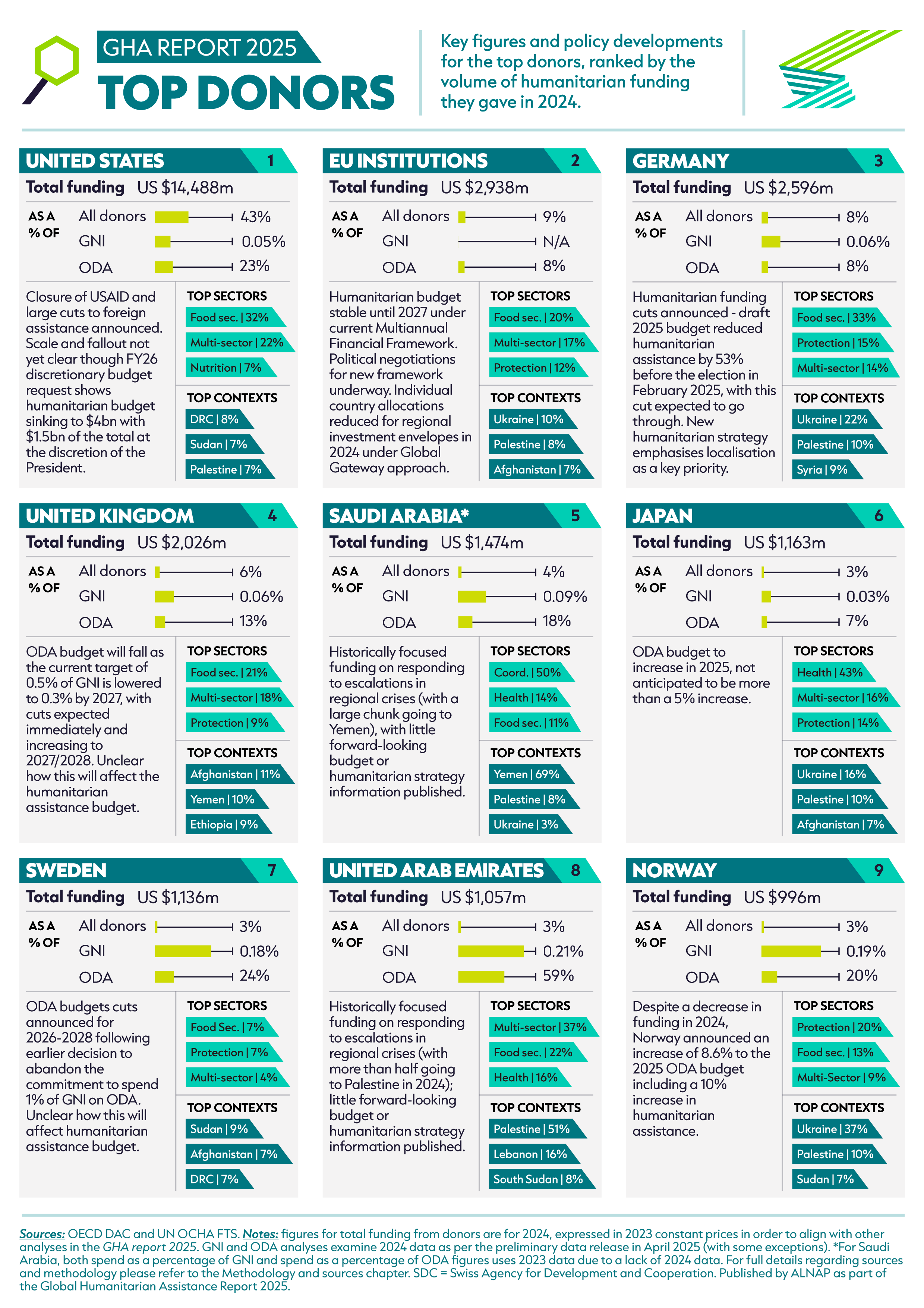
  • Infographic: Top donors

Infographic: Top donors

ALNAP GHA - Donors - D5 - 1408v1 - 1
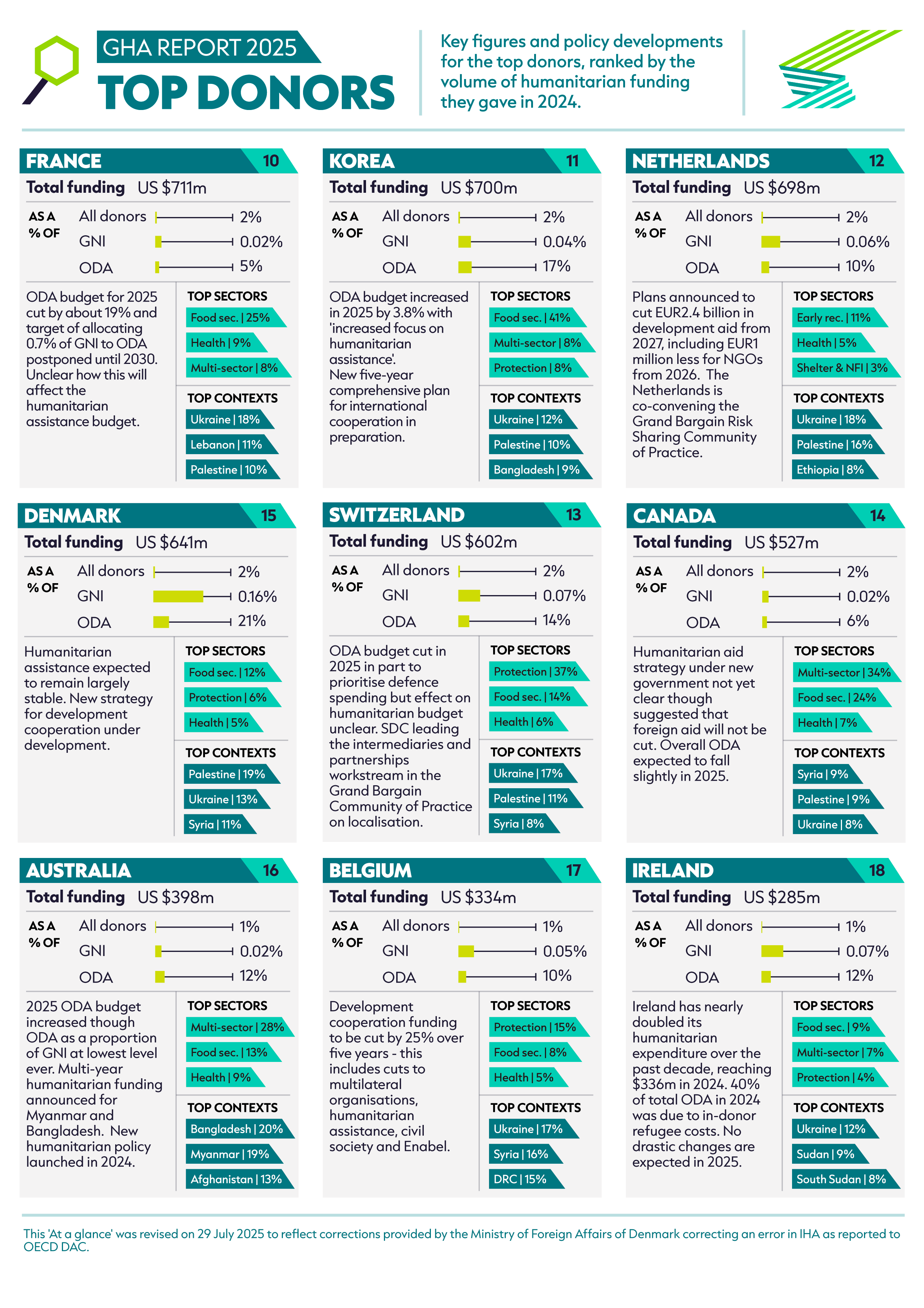
ALNAP GHA - Donors - D5 - 1408v1 - 2

Download Infographic: Top donors documents

  • English | PDF 153KB

Previous

The Humanitarian funding landscape

Read about The Humanitarian funding landscape now

Next

Reforming amidst crisis

Read about Reforming amidst crisis now

ALNAP

Sign up to our bulletin

  • Submit a resource
  • Privacy Policy
  • Submit an event
  • Terms of use
  • Submit a job/opportunity
  • Contact us

Follow us