Introduction
Making the most of limited resources bears life or death consequences in humanitarian aid. Shrinking aid and proliferating crises are making such decisions even more acute – especially when deciding who receives what in humanitarian responses.
When needs are complex and diverse, and when they far outstrip resources, it is deeply challenging to decide fairly and equitably who and where should receive humanitarian assistance.1 Those challenges are ethical as much as they are logistical; they are about purpose as much as politics, processes and practicalities.
Over the past three years, two major shifts have impacted how humanitarian resources are allocated. The first shift began in 2023 with the roll out of the Joint and Intersectoral Analysis Framework 2.0 (JIAF 2.0). This method is used to analyse and aggregate total figures on humanitarian need and forms the basis of appeals costs in Humanitarian Response Plans (HRPs – now referred to as Humanitarian Needs and Response Plans or HNRPs). HNRPs are the main planning tool for United Nations-led (UN) responses and also a primary resource for donors in allocating their global budgets. The roll out of JIAF 2.0 heralded a multi-year process, led by the UN Office for the Coordination of Humanitarian Affairs (OCHA), of ‘lightening the Humanitarian Programme Cycle’. This has significantly strengthened standardisation and sought to improve the quality of processes across HNRPs. The JIAF process also introduced criteria to tighten the scope of humanitarian response, which, while deemed necessary to address the significant over-stretching of humanitarian capacity, has been contentious.
The roll out of JIAF 2.0 has unfolded against the second shift – an intense escalation of pressure on response planning and agency allocation decisions caused by unprecedented cuts to humanitarian funding. These cuts began as early as 2023, but they were not widely recognised initially due to increased funding directed towards Ukraine and increases from the United States, which masked the general downward trend (Obrecht and Pearson, 2025). This trend accelerated dramatically in 2025 with the closure of the United States Agency for International Development (USAID) and major cuts announced by the top humanitarian donors. This is expected to result in anywhere from a 34% to a 45% drop in humanitarian funding in 2025 compared to 2023 figures (ALNAP, 2025).
As people are removed from feeding programmes or see their last lifelines of cash assistance cut entirely, the choices that humanitarian donors and agencies are making are more consequential than ever. The degree to which these decisions are made ethically and soundly may forever shape the future integrity and relevance of humanitarian action.
This paper reviews the core issues facing humanitarian decision-makers on who, where and what to prioritise in response planning. We provide a framework for making these decisions more ethical, transparent and participatory. We cover two main aspects of resource allocation: scope setting and prioritisation. These are interlinked but separate processes: scope setting is the act of deciding what falls within a prioritisation exercise versus what is deemed ‘out of scope’; prioritisation is the act of weighing different values and objectives against costs and ranking them.
The core audiences for this paper are decision-makers who allocate resources between countries (eg donors), and those tasked with prioritising resources within them (eg Humanitarian Country Teams or HCTs). The paper is not intended to replace existing guidance for HCTs and others in their analysis and planning process. Rather, our aim is to support the application of existing guidance in an ethical and principled manner.
We view prioritisation and scope setting primarily through the lens of the internationally funded humanitarian system and the dilemmas thrown up by its ethos, structures and ways of working. We include local and national organisations in this lens, but we do not address the prioritisation challenges they face with their communities outside the internationally led system. This is largely because local actors will not be confined to the same protocols and parameters, and they will have a wider set of values and concerns to draw on in their decision-making.
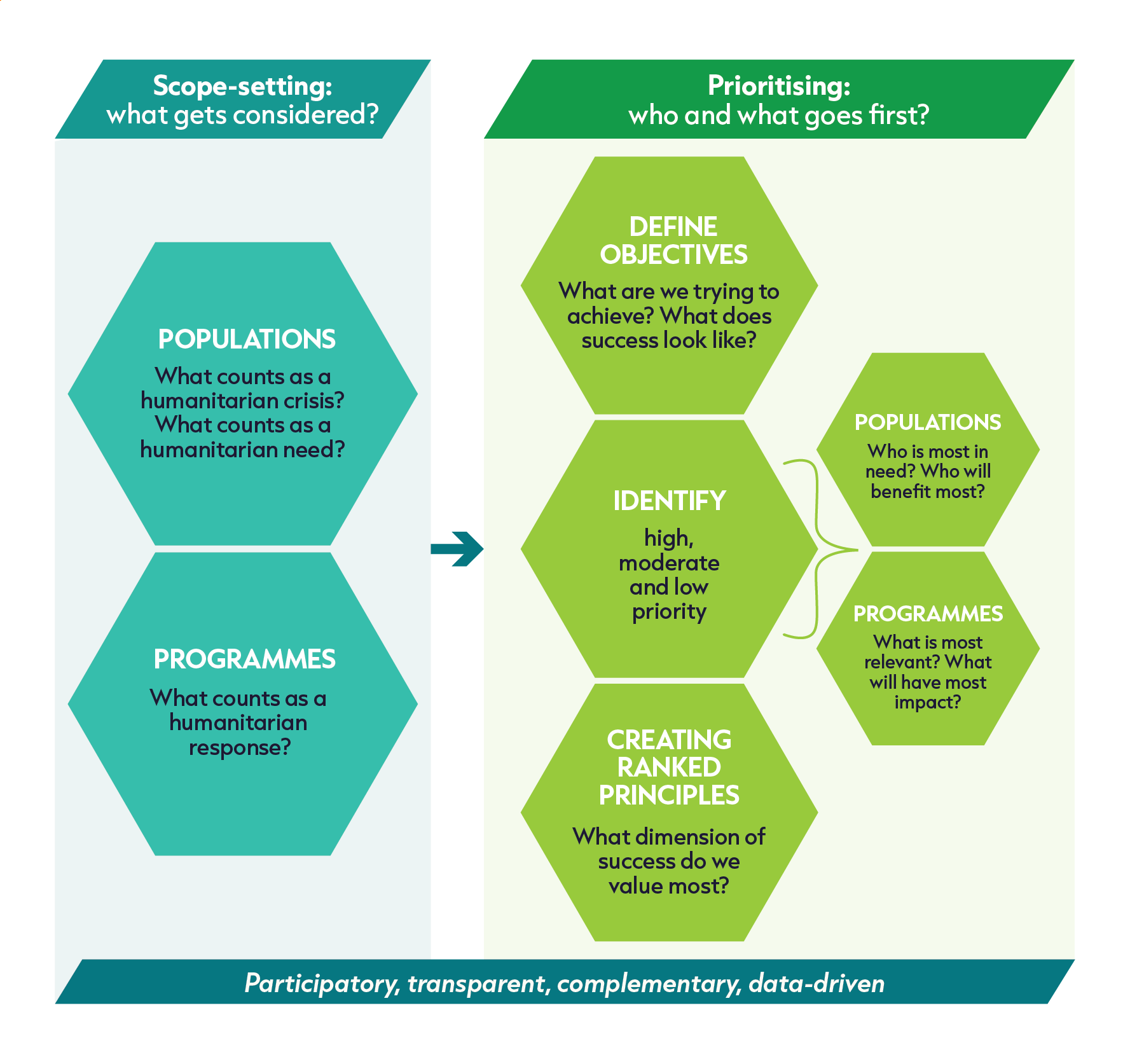
Building on learning from present approaches within and beyond the humanitarian sector (WHO, 2014), this paper describes a four-stage framework for prioritising populations and programmes:
- Pre-prioritisation: Scope setting – defining ‘humanitarian’ parameters (section 2).
- Prioritisation step 1: Identifying what an ideal response would achieve (section 3).
- Prioritisation step 2: Identifying ‘priority populations’ and ‘priority services’ through evidence and consultation (section 3).
- Prioritisation step 3: Balancing multiple priorities using ranked principles (section 4).

Figure 2: A framework for deciding who and how to help in humanitarian response planning