Scope setting: defining humanitarian parameters
While scope setting can be viewed as a first step in prioritisation, it is in many ways distinct. The act of prioritising weighs different values or outcomes against one another. Scope setting, in contrast, is a blunt tool that determines which goals, values and outcomes should be considered at all for prioritisation. Being kept ‘within scope’ does not guarantee that a person will be prioritised, but being left ‘out of scope’ guarantees that person will not be considered at all.
Scope setting is therefore a significant act of power, particularly in humanitarian contexts. It determines who gets counted and what services are considered. It can play an important role in shaping how communities and people affected by crises experience humanitarian aid, and therefore it is necessary to interrogate decisions on scope setting and expect transparency.
Humanitarian scope setting begins by answering the question: what is humanitarian action for? There is no single shared answer to this, as we discuss in our framing paper (Swithern and Obrecht, 2025). However, some core concepts feature regularly, namely: referring to certain ‘crises’ or ‘shocks’ as the conditions, referring to the principle of humanity as the imperative, and using ‘life saving’ and ‘dignity’ as the frame for action. Many humanitarian organisations also refer to prevention and preparedness for crises in their definition of scope, although there can be wide variation in their interpretation of what sorts of preventative actions count as ‘humanitarian’. Ultimately, each donor or agency will have its own working definition of humanitarian action – for the purpose of this paper, we continue with a widely used and working minimum definition of scope for humanitarian action:
To save lives, to prevent and alleviate suffering, and to maintain human dignity during and after crises.[1]
Applying this scope practically requires that humanitarian actors clarify their position on who is ‘affected by crisis’ and experiencing ‘humanitarian’ suffering, and what, if any, programmatic approaches are beyond their consideration for humanitarian action.
It is important to note that, in practice, particularly in the Humanitarian Programme Cycle (HPC),[2] scope setting tends to be defined only in terms of who gets included. It refers to the identification of which populations fall within scope for a needs assessment (OCHA, 2025). Generally it is not used to refer to the practice of determining whether certain services or activities are ‘'humanitarian’ or ‘not humanitarian’. However, ruling out services or programmes carte blanche on the basis that they are ‘development’ activities is a form of scope setting: it removes certain interventions from consideration entirely, even if these are the most effective means for addressing a humanitarian need. For example, often, humanitarian agencies will not engage in road construction, even if a paved road is the most effective way to address protection risks.
Therefore, we use scope setting here to refer to who humanitarian agencies deem ‘out of scope’ as well as what provision they deem out of scope. Both topics have received significant renewed attention and revision at the response level in recent years.
2.1: Populations: who is ‘affected by crisis’ and who is ‘in need’?
Two concepts are used to delineate scope for the populations that humanitarians engage with – first by identifying who is ‘affected by crisis’ and then, within this group, by identifying who has the relevant ‘humanitarian needs’.
Defining crises and those affected by crisis
While at times perceived as straightforward, applying the concept of a ‘crisis’ to humanitarian scope is contested and complicated in at least three ways.
Selecting certain types of crisis: Due to the history of how humanitarianism emerged, the idea of a ‘humanitarian crisis’ for many years centred on one of three scenarios: (i) conflict involving military or militant armed groups, (ii) climate/’natural’ hazard-caused disaster, or (iii) internal or cross-border displacement caused by (i) and/or (ii). This list leaves out other ‘crises’ that, some have argued, can produce similar levels of life threatening or life worsening conditions, such as urban gang violence or drug epidemics (Lucchi, 2014). Over the past decade, driven by increases in human and animal disease, epidemics and ‘plant and animal pests and diseases’ have moved up the list of crises considered within scope for humanitarian response. These feature alongside conflict and climatic disasters as the four core crisis types to be considered in the 2026 HPC (OCHA, 2025), with economic crises and displacement considered as part of an optional extended list of shocks.
Defining deprivation differently: A person can be seen as in need of emergency support because they belong to a demographic category, or because they are unable to meet a basic needs threshold. While humanitarians use thresholds (severity ratings) in their prioritisation process, for scope setting they rely primarily on a category approach, identifying a ‘population affected by crisis’, or, in some cases, certain ‘vulnerable’ demographic groups (eg displaced people, women and children) and drawing their scope around these populations only.
This category-based approach to humanitarian scope is frequently critiqued as shoring up an unjustifiable distinction between equivalent needs. People living in extreme poverty can experience similar, or even worse, levels of deprivation as those who are affected by conflict or disaster in the same country – yet, in the internationally constructed aid system, the first are deemed in need of development cooperation and the second humanitarian assistance (Obrecht, 2017; Kidd and Athias, 2020). This distinction has prompted reflection and debate in attempting to reconcile work on linking developmental social protection systems (often using thresholds) with category-based humanitarian cash assistance. The categories applied by humanitarians are also seen as arbitrary by many local actors, but as necessary by key international humanitarians who have pragmatic and principled reasons to keep a tight scope in an era of shrinking resources and space (Albiento, 2025).
Setting a ‘crisis’ timeframe: A major aspect of humanitarian scope setting involves delineating where the humanitarian role sits within the timescale of a crisis.
The idea that humanitarian action is a response to a crisis has shaped how many view the scope of humanitarian action, inhibiting the uptake of preventative measures and narrowing the time window for humanitarian anticipatory action. Earlier action and risk reduction are often left for development budgets to cover, despite disaster risk reduction (DRR) being chronically underfunded within development (Development Initiatives, 2023).
Protracted crises, in contrast, have stretched the timeline for humanitarian engagement from weeks or months to decades in some countries. They consume a majority of humanitarian resources and have prompted calls for development-supported exit strategies and a tighter focusing of humanitarian actions away from being the default provider of basic services (ALNAP, 2025).
As one example of how humanitarians are grappling with this presently, guidance for the 2026 HNRPs points to a rethinking of how scope is set in protracted crises:
in recent years, distinguishing people affected by a crisis from the total population has received less attention in many countries, in part due to the increased duration of appeals (with the average HRP now running for more than 10 years) and the assumption – over time – that the country’s entire population is “in crisis”.
(OCHA, 2024: 3).4 (see attribution below)
(OCHA, 2024: 3).[3]
Defining ‘people in need’
Even with a tight scope for defining who is ‘affected by crisis’, there remains a wide range of needs and priorities that humanitarians can address. For decades, humanitarian response has been shaped around the concept of a humanitarian ‘need’ – a gap or lack in a perceived basic level of well-being. Needs provide scope to the services offered by humanitarian actors (see Section 2.2 Scope-setting programming below) as well as scope to the populations who receive humanitarian assistance, because needs are used as the basis for assessments.
A ‘People in Need’ (PiN) number is created by identifying the number of people within the population affected by crisis ‘Whose current level of access to basic services, goods and social protection is inadequate to re-establish normal living conditions with their accustomed means in a timely manner without additional assistance’ (OCHA, 2016: 5). In a country such as Bangladesh or Pakistan, for example, upper-middle-class families may count as part of the population affected by crisis if their properties are damaged by flood. However, due to their ability to cope with the impacts of a disaster, these families typically would not be included within the PiN, as they are not deemed to be in need of humanitarian assistance.
The concept of a humanitarian need is vague and defining it has been a top-down process primarily, dominated by international humanitarian perspectives (Slim, 2023). Even then, amongst humanitarian agencies there are many interpretations and uses of ‘need’ as a guiding concept. Some use ‘needs’ to refer to a measurable lack in well-being, for instance, while others use ‘needs’ interchangeably with specific sectoral solutions.
Changes to scope setting that shift how people in need are counted should be undertaken with caution. Comparing PiN numbers year to year has always been a challenge, due to the different methodologies applied. However, some basic consistency in approach has been maintained. Major changes to defining the scope of humanitarian action, particularly in a period where funding is falling dramatically, risks sending the message that previous needs estimates were significantly over-inflated, or that needs will be defined by the resources available rather than by the actual impact of crises. The guardrails put in place to separate estimates of who is in need from the practicalities of fundraising have always been thin, but they are important in maintaining the integrity of the analysis used to justify humanitarian intervention.
2.2: Scope-setting programming
A major source of ambiguity in humanitarian prioritisation processes is understanding the degree to which certain solutions and services are deemed ‘out of scope’ by humanitarian agencies from the outset, as opposed to simply being de-prioritised due to more urgent and pressing concerns. This presents particular challenges to claims that humanitarian action is ‘people-centred’, as communities frequently ask for services and support that are either creatively outside the humanitarian toolkit (eg wheelbarrows) or are deemed by humanitarian agencies as a ‘development’ responsibility (ALNAP, 2022; Ground Truth Solutions, 2025).
After the World Humanitarian Summit in 2016, funding increased and the humanitarian–development–peace (HDP) nexus became a dominant policy issue. Since then, the ‘big tent’ approach to humanitarianism became more widespread, which embraced resilience-building and offered more scope for addressing peoples’ longer-term priorities. Simultaneously, for donors seeking to maintain a narrow focus for their humanitarian spending, agencies increasingly presented a larger number of services as ‘life-saving’ in order to attract humanitarian funding. This stretched the already vague concept of a humanitarian need even further. Both drivers – the HDP nexus expansion and the redefinition of services as life-saving – have created what Hugo Slim (2023: 3) refers to as a ‘Christmas tree’ approach, broadening the scope of humanitarian action to include an ever-expansive set of issues. Now, constrained resources mean for many a paring back to ‘essentials’, alongside questions as to what this means in practice.
There remains considerable ambiguity around the invisible dotted line in humanitarians’ heads about what constitutes a ‘humanitarian’ vs a ‘development’ solution. In reference to Figure 3, humanitarians seem clear that they engage in short-term solutions (A) and do not engage in initiatives that take years to see benefits (B). Some humanitarians engage in resilience work that delivers a mixture of medium- and long-term benefits (C). But there are real questions around solutions that could address both a humanitarian need and its driver(s) (D) – and whether these are deemed out of scope even if they address immediate humanitarian needs.
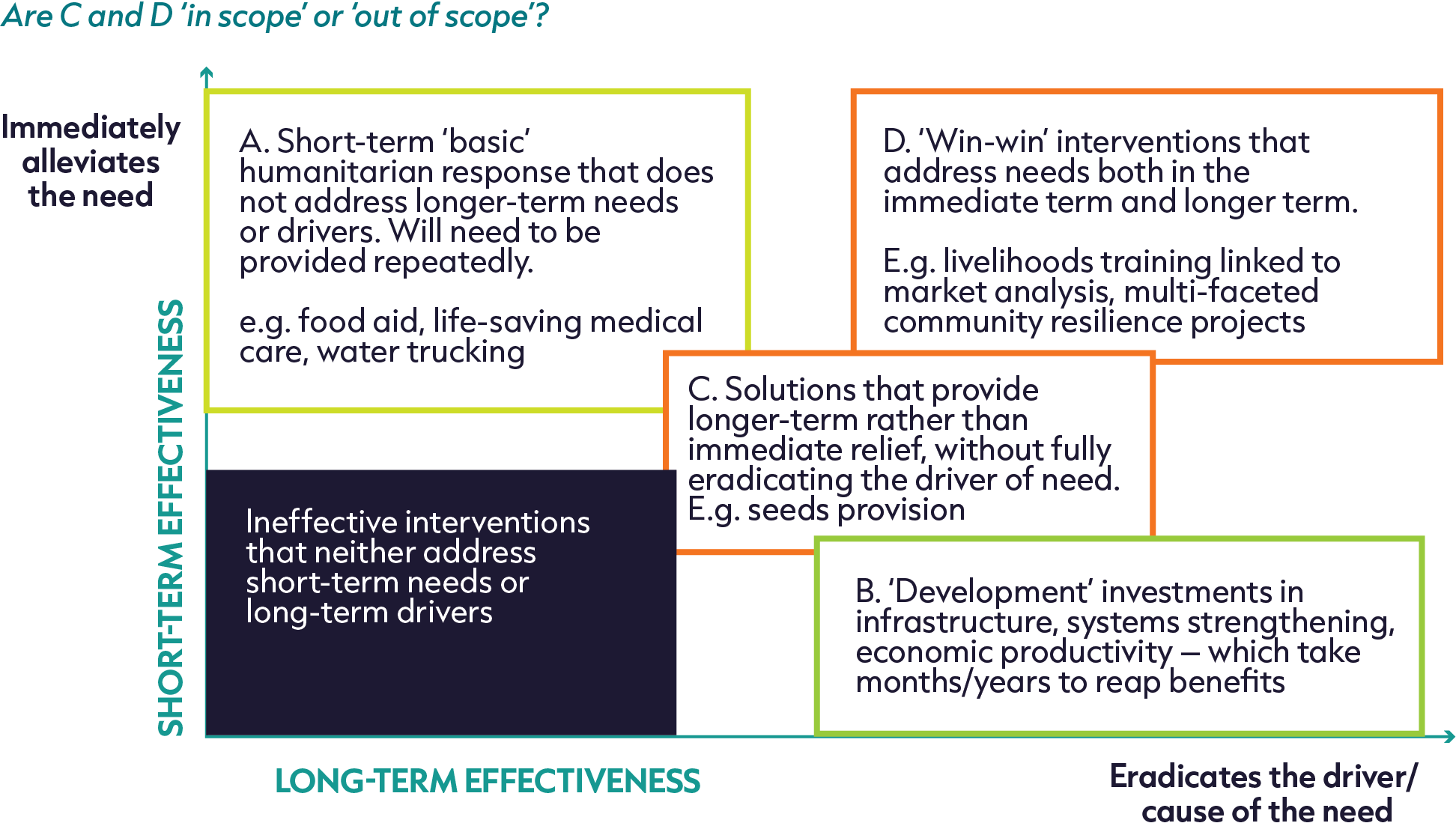
Some might point to the role of response objectives in shaping which humanitarian activities are considered within scope – if a response has an objective to support resilience (see section 3), then it will include a wider range of services beyond immediately saving lives. Humanitarians can also take resilience into account in how they provide life-saving support, providing ‘win-win’ interventions (Box D in Figure 3). Examples include the work of the International Committee of the Red Cross (ICRC, 2015) on sustaining water infrastructure in urban conflict zones over water trucking, or the Food and Agriculture Organization combining seed distribution with food aid to support a combination of short- and long-term food security outcomes (FAO, 2023).
2.3: How narrowly should humanitarians set their scope?
Fundamentally, the choice faced by decision-makers on scope for any of these concepts – shock, people in need, programming – is whether to take a narrow or broad approach. When scope is narrow, prioritisation of resources is often simpler, as there are fewer demands on available resources. When scope is kept broad, prioritisation can be more difficult, as there are more options for what one can do with limited available resources. This issue is of intense ongoing debate at present and carries significant consequences.
In the process of producing this paper, ALNAP heard multiple perspectives on how narrow or broad the scope should be set for humanitarian action. This is particularly true with regard to the recent shifts in HNRPs towards scope setting around a specific list of shocks. Rather than take a position in this paper, we summarise the two perspectives.
Reasons to narrow the scope: Humanitarians need to be more realistic in the face of significant challenges. They can no longer act as the primary duty-bearers to people living in protracted crises, nor can they continue to offer a ‘Christmas tree’ of services addressing the full range of people’s vulnerabilities and concerns (Slim, 2023). This is not only a matter of insufficient funding for direct programming for people affected by crisis – critical funding is also hollowing out for the data services needed to identify and target those in need. Without tighter scoping criteria for who they target and what they offer, humanitarians risk spending too much time and resources on measuring the size of need and too little on addressing it. A reduced scope reduces the cognitive burden on an overstretched humanitarian system and is more honest about the limits of humanitarianism in this new era.
Reasons to return to a broader scope: While the motivations leading to the narrowing of scope for humanitarian response are understandable, it risks making humanitarian action feel further removed from the perspectives and priorities of people affected by crisis. And these people already see their lives in a much more interconnected way than the formal aid system. A core function of humanitarianism is to bear witness to needs not simply to address them – casting out large swaths of people due to tightened budgets swaps out solidarity with silence.
The use of shock-based scoping in particular exacerbates the tensions that are implicit with using a category-based approach and raises the risk of seemingly arbitrary cut-offs. For example, an emphasis on recent shocks may mean that those recently affected by flood are within scope for humanitarian needs assessments, while someone who is still poorly off from a flood they never recovered from one year prior is not. Similarly, this approach may treat those recently displaced as having humanitarian needs but not someone who has lived as an internally displace person (IDP) for a decade.
While the problem of over-stretched humanitarian resources is real, there may be more desirable solutions to addressing this in humanitarian prioritisation processes. Applying arcane criteria that remove entire populations from the scope of needs assessments, or which focus only on particular types of ‘need’, risks making humanitarianism more pedantic than principled. And when these criteria are applied differently from country to country, it introduces inequalities. When prior funding data is used to set the scope for future responses, a narrower scope risks compounding the plight of those stuck in forgotten crises.
Footnotes
-
There are few collective definitions of humanitarian action and response. This definition largely draws on the Good Humanitarian Donorship principles (GHD, 2023).
-
The HPC is the annual process through which UN-led HCTs compile their assessments of need and estimates of cost to respond. Taken together, the HNRPs are synthesised into a Global Humanitarian Overview, which provides the most comprehensive and coordinated global picture of needs and response requirements and, as such, plays a unique role in describing and setting the parameters for international efforts.
-
When applied to the 2025 HRPs, this approach in some protracted crises meant that assessments were only conducted for populations who had experienced a specific and recent shock such as a flood or acute outburst of armed conflict. This caused some concern that populations traditionally considered for humanitarian support had been scoped out of needs assessments. These issues have been addressed to some degree in the guidance for 2026, which notes the need to allow exceptions for areas experiencing acute increased mortality or severe acute malnutrition (OCHA, 2025).