Addressing purpose-related trade-offs and tensions
3.1: Facing the tensions
Contrary to aspirational rhetoric, it is not possible to simultaneously and equally prioritise all six humanitarian purposes illustrated in Figure 3. Even in a less constrained funding environment, these objectives cannot exist in equilibrium. The current acute resource constraints throw the trade-offs into stark relief. We highlight three of these.
3.2: Ensuring dignity and agency versus life saving
‘People first’ or ‘people-centred aid’ is often positioned as a ‘chapeau’ principle in proposals for the future of humanitarian action – including in the Emergency Relief Coordinator’s (ERC) Humanitarian Reset (Fletcher, 2025) and the UN 80 Initiative’s Humanitarian Compact (UN, 2025) – in line with the purpose of ‘ensuring dignity and agency’. Yet this principle often sits in tension with other pre-set priorities, even within the same strategic document.[1]
If this principle is to be fully realised as a priority, it has implications for the prioritisation of a menu of ‘life-saving’ interventions based on internationally agreed metrics of need severity – as we discuss in our accompanying paper (Obrecht, 2025). While people suffering acute crisis might identify similar priorities to humanitarian ‘life-saving’ support, surveys of people affected by protracted crises also often reveal a preference for support for self-reliance over emergency basics (Ground Truth Solutions, 2025; ALNAP, 2022). Ensuring that people have agency in deciding and directing the aid they receive involves investing resources in a very different operating model – potentially one that prioritises a locally led over a multilaterally led model.
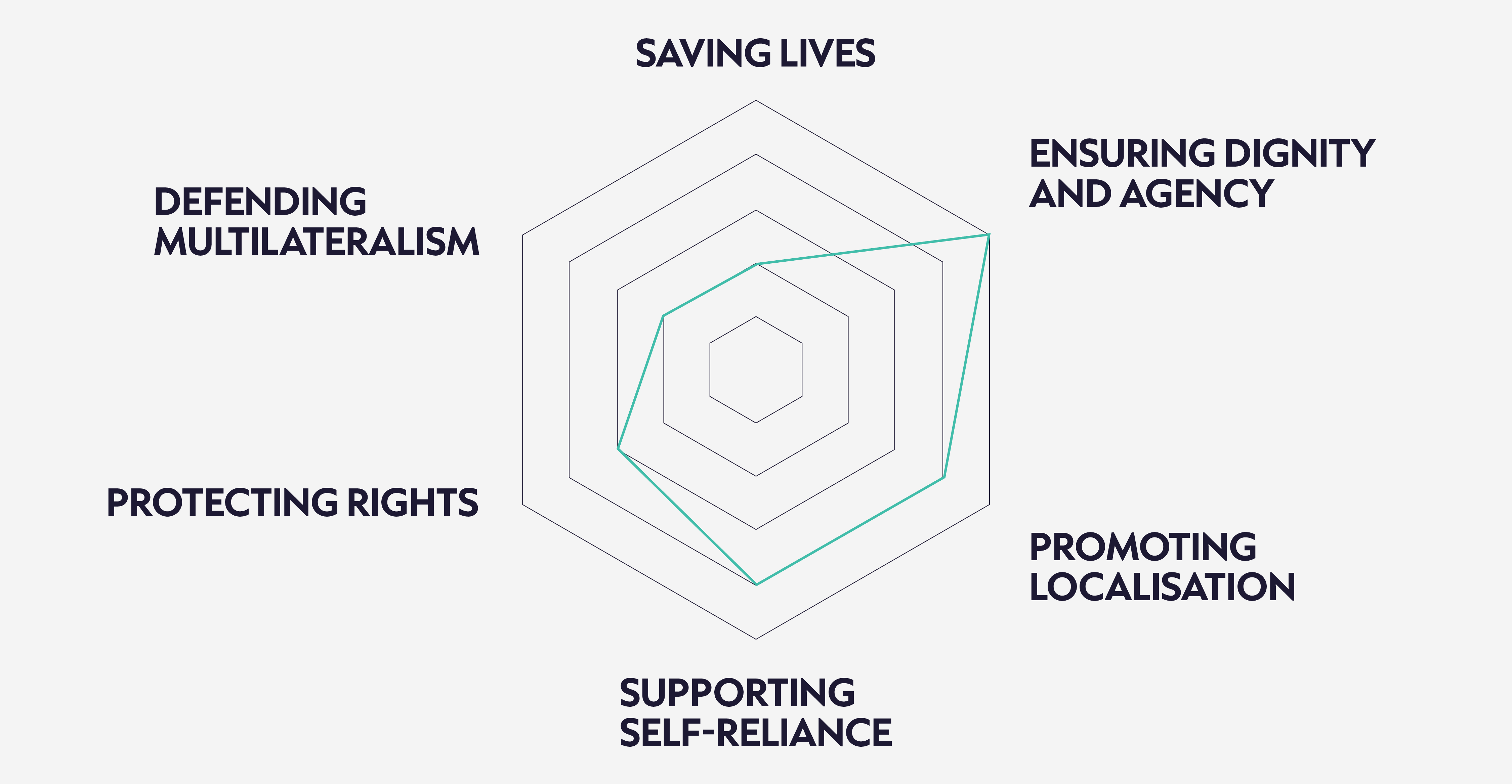
This diagram illustrates the concept of potential trade-offs. It does not assign fixed values and recognises that the actual shape will vary by context.
3.3: Defending multilateralism versus promoting localisation
The tensions between multilateralism and localisation are also well rehearsed. Most international humanitarian actors have signed up to some form of localisation commitment as a priority, yet they also retain a belief in the importance of a multilateral system. This is not necessarily a tension, but it can become so in decisions about resource prioritisation at the organisational and system levels.
Donors are highly motivated to support the work of UN agencies, both for pragmatic and ideological reasons. Ideologically, the UN system represents a collective approach to humanitarianism and a central part of the post-1945 rules-based international order – at a time when its shared norms are under threat (IARAN, 2025). Pragmatically, UN agencies are highly effective at absorbing risk, providing an easy win for donors needing to get large grants out the door. But these virtues are traded off against the rigid, top-down hierarchical systems employed by UN agencies in their ‘partnerships’ with local organisations, and in collective decision-making bodies that historically have featured very little power-sharing.
As part of the ERC’s humanitarian reset, there have been some suggestions for uniting multilateralism with localisation, the most notable being calls for increased funding to UN-managed country-based pooled funds with targets for channelling those funds through local actors. While these calls may be posited as a useful reconciliation between two opposing directions, they are ultimately weighted towards prioritising the centrality of multilaterals, due to the nature of their governance and financing terms.
A more localisation-weighted alternative – endorsed by some local actors themselves – may be to explore how the multilateral system can shift from an operational to a more normative and diplomatic role for multilateral agencies, supporting and protecting the space for local actors to operate (Barter et al, 2025).
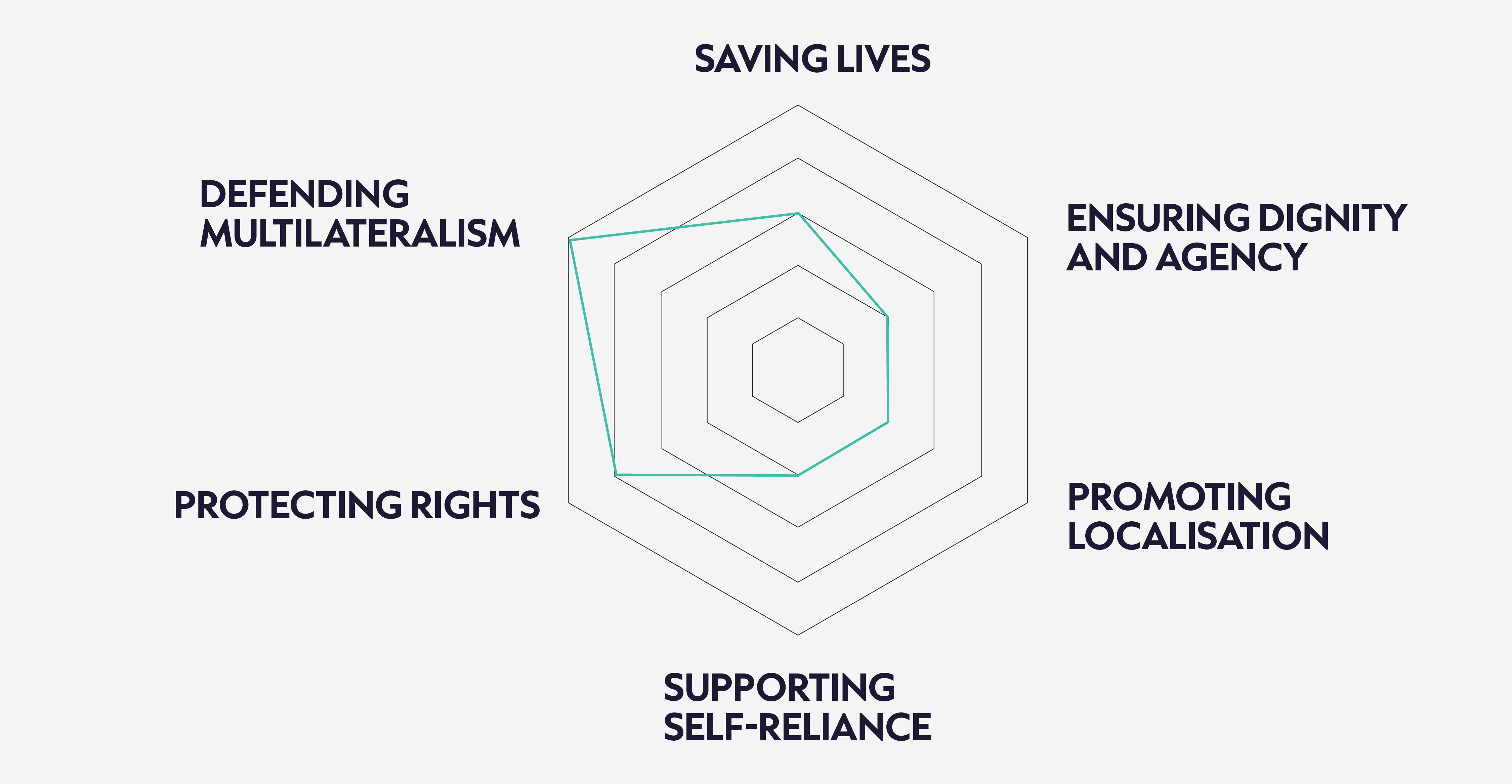
This diagram illustrates the concept of potential trade-offs. It does not assign fixed values and recognises that the actual shape will vary by context.
3.4: Protecting rights versus saving lives
In many conflict settings, advocating for International Humanitarian Law (IHL) to be upheld is in line with preserving humanitarian access. In other contexts, pursuing this priority is in tension with maintaining presence to deliver support. This tension is negotiated daily at the operational level in most complex crises,[2] and it comes to the fore at a diplomatic level in geopolitically high-profile conflicts. This may appear to be less of a resource prioritisation choice than a principles dilemma, but in fact it has implications for decision-making at the population, programme, organisational and system levels.
At a population level, it drives choices about how far reachability or severity should determine which communities are prioritised. At programmatic level, it shapes choices around investments in protection. At organisational and system levels, it points to a greater emphasis on diplomacy functions – as the UN 80 Humanitarian Compact begins to suggest.[3] But it also plays into the tensions around multilateralism and localisation too. Where the international system prioritises protecting rights – or is nonetheless denied access – it tends to rely on local actors to shoulder the risk of delivery, and so implies greater and more systematic investments in mitigating their risks and protecting their space.
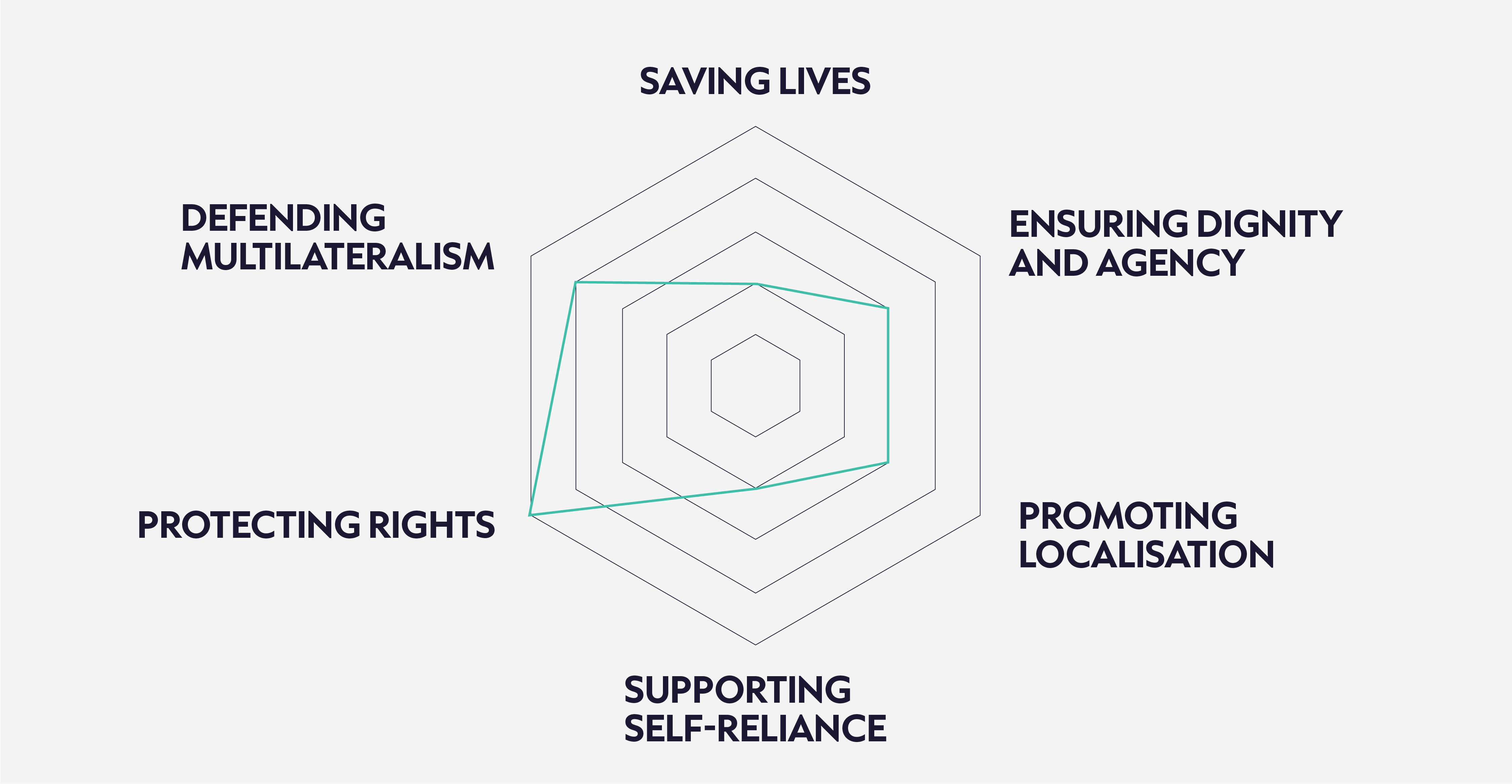
This diagram illustrates the concept of potential trade-offs. It does not assign fixed values and recognises that the actual shape will vary by context.
Footnotes
-
For example, strategic documents published by some organisations offer localisation and community empowerment as a framing principle, but they go on to describe a pre-set sectoral menu.
-
See the principles chapter in ALNAP (2022).
-
The UN 80 Humanitarian Compact does not address the question of organisational configuration and resourcing for diplomacy, but it does emphasise the need to bring agencies together to speak with one voice under a new Collaborative Humanitarian Diplomacy Initiative (UN, 2025).