Framing the types of decision-making challenges
2.1: Four challenges
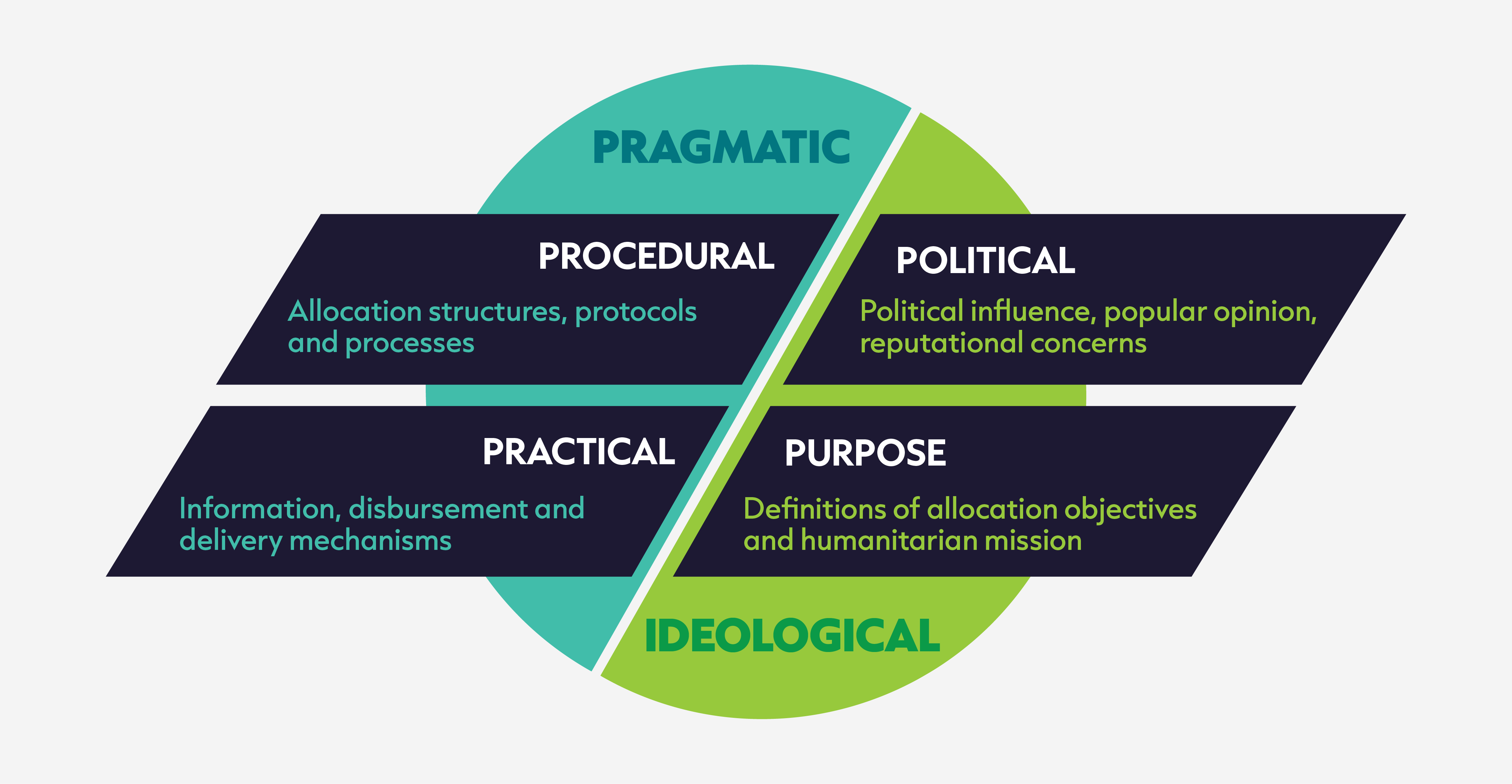
Resource prioritisation across these four areas (populations, programmes, structures and systems) is beset by four challenges. Two are pragmatic in nature and two are ideological (see Figure 2 below).
Such pragmatic and ideological considerations are not unique to humanitarian action – they are common to the resource allocations faced around other public goods, such as national healthcare provision. But they present specific challenges in the humanitarian aid sector, which we outline below. In many ways these challenges are intertwined – ideologies shape the procedures and practicalities – but purpose-related challenges demand a new level of honest attention as the humanitarian system attempts to recalibrate or reinvent itself.
2.2: Procedural challenges
What we describe as the international humanitarian ‘system’, in fact comprises diverse and independent moving parts. These are loosely interconnected and they lack coherent and transparent procedures for allocating resources collectively. This creates multiple challenges for the efficient allocation of scarce resources.
In theory, the fact that there is no single actor, body or process responsible for ‘system design’ or resource allocation allows for more distributed and democratised decision-making. Yet, in reality, decisions are made by separate but interlinked pockets of high-influence stakeholders, often with little transparency or opportunity for others to shape decisions.[1]
The Humanitarian Needs and Response Plans (HNRPs), managed by the UN Office for the Coordination of Humanitarian Affairs (OCHA), are the clearest collective procedure for prioritisation. They serve as a multi-agency estimation of needs in a humanitarian crisis, an articulation of what programmes and services are required, and their associated costs. These processes focus on the sub-national aspect of populations (who within a geographic area or crisis will be targeted, not which countries or crises globally should be prioritised), and on prioritising programmes (the types of responses under or spanning the humanitarian clusters that should be prioritised). However, despite efforts to clarify and standardise procedures, the calculus of prioritisation – what the most recent Global humanitarian overview calls the ‘cruel math’ of prioritisation (OCHA, 2025a) – can remain opaque and swayed by the priorities of individual organisations and donors. We discuss this in our accompanying paper (Obrecht, 2025).
The HNRPs are grounded in guidelines and formulae for assessing needs (see Practical challenges section below). But they also reflect the sum of the prioritisation choices of individual humanitarian agencies who participate – predominantly UN agencies and international non-governmental organisations (INGOs). Agencies decide which programmes to design and offer, and where to open in-country offices, and their presence and reach directly affects the parameters of the prioritisation of populations and programmes. This presence and reach has always been shaped to some extent by financial factors and preferential pathways (Healy and Tiller, 2014). However, the recent liquidity crisis has prompted a speed and severity of organisational cuts that have outpaced strategic reprioritisation. Reduced bandwidth, capacity and presence are creating facts on the ground that shape the prioritisation of future efforts.[2]
Agencies’ decisions are thus clearly shaped by donor decisions on which geographic areas to engage in and which sectors to fund. While this is also a political challenge (see Political challenges section below), procedurally here too, fragmented decision-making undermines effective prioritisation. At a global level, there is no formal coordination to support these decisions collectively and, indeed with donors, decisions can be split between departments, ministries and devolved country offices.[3]The Good Humanitarian Donorship group does not function as a collective decision-making body (Swithern, 2024), and although coalitions of ‘like-minded’ donors and UN agency donor support groups provide space for some coordination, these are exclusive to smaller and self-selecting groups of donors.
2.3: Practical challenges
Many well-documented practical challenges of humanitarian prioritisation centre on having quality data to make decisions – and having the staffing and resources to gather and make sense of this data.[4] The short and shifting timeframes around prioritisation decision-making in the wake of the 2025 aid cuts have compounded these challenges, and they have also compromised data capacities. As we explore in part 3, this impacts the ability to ensure meaningful consultation of people affected by crisis, at the same time as reducing assessment and analytical investments. Gaps and asymmetries in information mean humanitarian actors can be making decisions in the dark.
For the humanitarian system, the ecosystem of risk analysis and humanitarian data collection and analysis underpins impartial assessments of vulnerabilities and needs. These assessments include the Joint Intersectoral Analysis Framework that is used to generate the people in need (PiN) metrics in the HNRPs, as detailed in our accompanying paper (Obrecht, 2025), as well as a wider set of food-insecurity, climate and health monitoring systems. However, these data monitoring and analysis mechanisms – particularly those funded and hosted by the United States government[5] – were among some of the first casualties of the aid cuts in 2025, stymying informed prioritisation decisions. Even when well funded, these data tools alone have limits: they are ultimately probabilistic and quantitative, and they demand investments in analytical ground-truthing if they are to inform people-centred prioritisation (see part 3) (Simons, 2025).
Lack of comparable information on other actors’ operational activities in humanitarian crises makes it difficult to assess how any individual donor or agency can best add value and avoid duplication. Mapping this organisational action is at the best of times difficult, but the current context of fast-moving programmatic changes and staffing in flux makes it exceptionally hard. At a country level ‘3W’ (who, what, where) coordination can help, but this rarely aggregates up to global decision-making and it is challenging to keep live. Funding uncertainties and ongoing major restructuring and down-sizing exercises within UN agencies and INGOs mean that there is a prolonged ‘zone of uncertainty’ about operation, in turn making it hard to factor complementarity and gap-filling into these restructuring efforts. International agencies also have collective blind-spots about the response efforts outside their ambit, with little operational understanding of local response modalities – both formal and informal.[6]
Evidence of cost-effectiveness is another practical area of weak information across the sector, making it hard to factor value into the prioritisation of scarce resources. Basic cost-efficiency data is hard to come by given the lack of transparent data on how much it costs different agencies to provide comparable goods and services[7] – a problem made all the harder by the volatile economic, supply chain and operational conditions in crisis contexts (Stoddard et al, 2017; ALNAP, 2018; ALNAP, 2022; Elrha, 2018; Baker and Salway, 2016). Consequently, this limits well-evidenced cost-effectiveness analysis (ALNAP, 2018 and 2022), which demands information about the outcomes of humanitarian interventions – information that is scarce from the perspective of implementing agencies, let alone from the perspectives of recipient communities. In the absence of real engagement with the difficulties of determining cost-effectiveness, prioritisation pathways often revert to a reductive focus on cost-savings.
2.4: Political challenges
Ideological issues feature in the more pragmatic challenges of procedures and practicalities discussed, but they are particularly pronounced in the political challenges in aid allocation. Political prioritisation often frames the window in which other prioritisation decisions can be made. Despite attempts to allocate according to humanitarian need, donors and agencies alike must grapple with influences that shape their presence and preferential pathways and that bend them towards sovereign, rather than collective, approaches (see section on Procedural challenges).
Politicisation of aid is not new: tensions between principled, needs-based humanitarian allocation and influences from political leaders and donor publics have long shaped the system (see Darcy and Hoffman, 2003). Domestic fiscal constraints, media coverage and popular opinion interact with donors’ foreign and domestic policy interests – from ‘soft power’ to migration management – to shape how much humanitarian aid is prioritised, what form it takes and where it goes. However, there is a new, marked shift towards an overt prioritisation of mutual interest and transactional goals as determinants for humanitarian engagement.[8] This is as compared to 20 years ago when the Good Humanitarian Donorship initiative attempted to establish guardrail principles in a wave of good intention to counteract concerns.
Politics also emerges in crisis contexts, where shrinking humanitarian space determines priorities de-facto. It can manifest in multiple ways: for example, undermining the delivery of support in states that are considered priorities for humanitarian aid, such as in Palestine; precluding prioritisation of countries or populations despite recognised severity of needs, such as in Myanmar; or contesting the existence of severe needs, such as previously seen in Tigray.
2.5: Purpose-related challenges
The procedural, practical and political challenges are distinct to prioritising humanitarian resources effectively. But they all circle back to the foundational challenge of the lack of clarity on the purpose – or objective – of humanitarian action. Whether and how a humanitarian actor articulates their aims will shape what that actor prioritises to achieve those aims.
Those who fund and implement humanitarian action do not share one central consensus on the purpose of humanitarian aid. The strategies of bilateral donors and multilateral and international agencies endorse a variety of objectives. At best, there is an overlapping consensus around the notion that humanitarian aid should be ‘life saving’ and protect people from the impacts of crises. OCHA’s analysis of the HNRPs – which to date have set their own strategic objective at country level – reveals a common set of aims, which it proposes should form the standardised foundation for future plans. These aims are to save lives and alleviate suffering, to protect safety and rights, and to sustain lives and livelihoods (OCHA, n.d.).
At the programme and population levels, these broad objectives reflect a range of perspectives on the degree to which humanitarian resources should be used to promote resilience or ‘improving lives’ rather than merely saving them; whether they should be used to anticipate and prevent crises, rather than merely to respond; and how much humanitarians should invest in community consultation. Purpose-related challenges play out at the system level too: for example, between those who consider localisation as part of a priority strategic objective of pursuing justice and equity, and those who see it as being more of an operational means to efficiently achieve life-saving objectives.
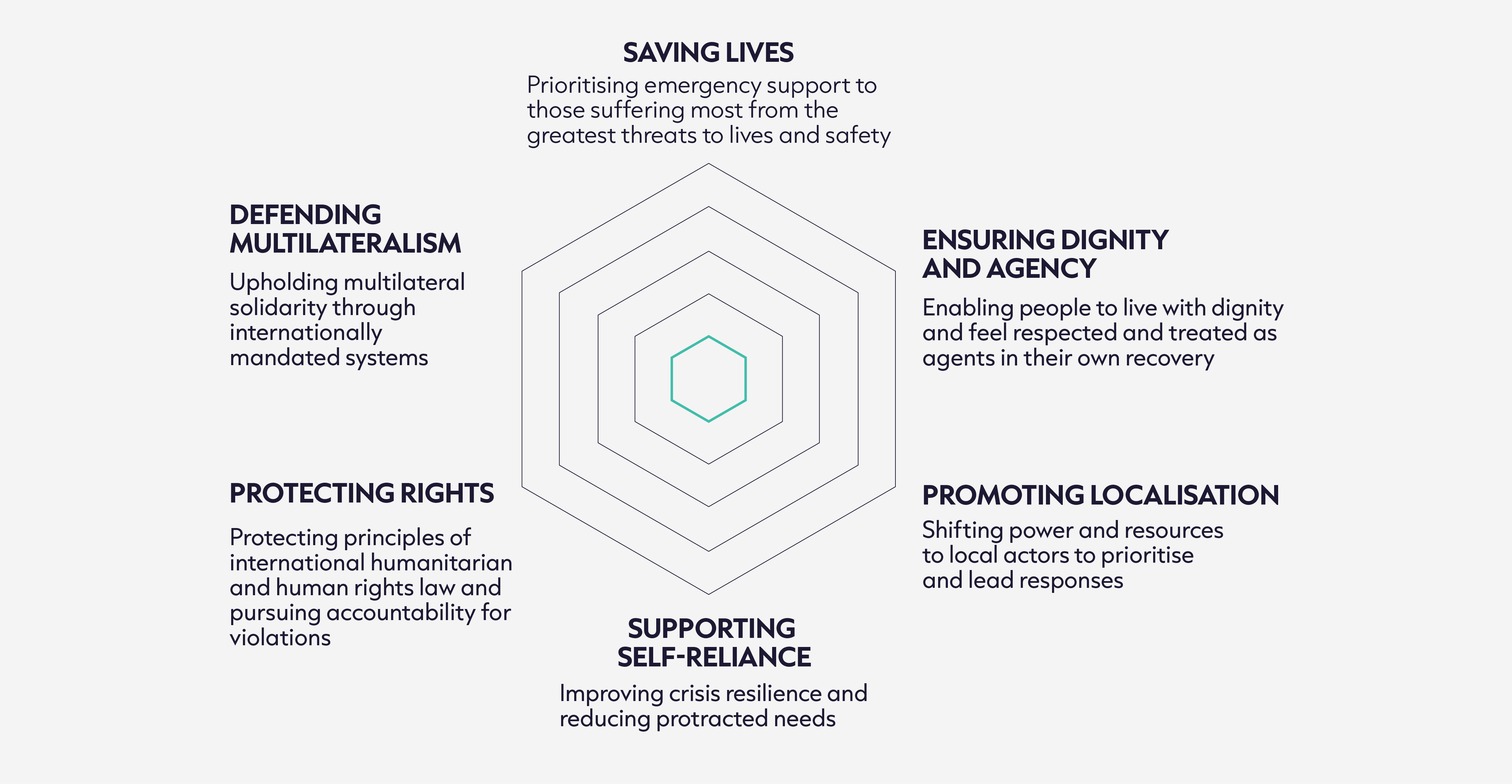
Six strategic objectives (purposes) are most visible and present in responses to the 2025 humanitarian financial crisis (see Figure 3 below). These objectives have been articulated in inter-agency, donor and organisational positions in re-setting and re-prioritising humanitarian action. While other objectives may exist,[9] the fact remains that there are contradictions between and within them. Within each objective, different actors in different places use different definitions – for example, it is by no means agreed what constitutes ‘life saving’.[10] And between each objective, as we explore in part 3, all six cannot take equal priority – allocation will involve trade-offs by necessity.
Footnotes
-
See, inter alia, Saez et al (2021).
-
For example, the Afghanistan ‘reprioritised’ HNRP is one of only a few of these country plans which gives an account of its methodology in any detail. It notes that clusters reduced activities and targets by factoring in response gaps analysis from the first half of 2024 and anticipated future funding shortfalls. ‘Given the current context and funding climate, however, clusters were asked to further prioritize by i) focusing primarily on life-saving activities under SO1 and protection-related activities under SO2 and dropping activities with low reach in 2024; ii) reducing the proportion of people targeted in line with projected declines in resources available; iii) and considering no longer responding in provinces where partners have recalibrated or reduced their presence’ (OCHA, 2025b).
-
For example, for some donors, core funding to UN agencies is handled by their respective ministries of foreign affairs, while programmatic funding to UN agencies and others is handled by the development ministry or department. For several donors, overall funding ‘envelopes’ are decided at headquarters level, while programmatic allocation decisions are devolved to country level.
-
See, for example, Darcy and Hofmann (2003); Knox-Clarke and Darcy (2014); Obrecht (2017); de Geoffroy et al (2015); Swithern (2018).
-
For example, FEWSNET – for 40 years the primary framework and mechanism for prioritising humanitarian responses to food insecurity, which is the largest humanitarian sector – was an early casualty of the US aid freeze. Dan Maxwell of the Feinstein International Center has expressed the impacts of this on prioritisation and decision-making: ‘My fear is that [it] would mean that there is no evidence on which to base the choice of [how to] allocate more food assistance’ (Worley, 2025c).
-
For example, evidence from multiple countries shows how humanitarian agencies have bypassed national social protection systems (see Phelps and Chandaria, 2025), and localisation studies repeatedly highlight the lack of understanding about national and local informal responses and safety nets (see Barbelet et al, 2024).
-
Some attempts have been made to overcome this – most notably with the Dioptra tool, a multi-INGO initiative to create a web-based cost analysis tool to use existing financial and monitoring data to rapidly estimate cost-efficiency of programme interventions. See https://www.dioptratool.org/.
-
The US was unequivocal about its aid priorities being politically driven, noting that it would fund ‘disaster relief when it fulfils the President’s foreign policy aims’ (Kerwin, 2025); the European Union’s (EU) official development assistance (ODA) is being reprioritised away from service provision towards a greater emphasis on infrastructure – in line with principles of its global gateway programme, framed as promoting economic development for EU partners as well as ensuring EU member states’ private-sector investments and competitiveness (EC, n.d.).
-
For example, cost-effectiveness and responsible use of resources are articulated as a key aim by some, and this aim was included in previous iterations of this tool (see Obrecht and Swithern, 2025). But we do not include it here as this objective is regarded as a means to achieving ‘higher order’ humanitarian purposes – such as saving lives.
-
As noted in our commentary piece (ibid.), life-saving can mean: whom we are trying to target for assistance (i.e. those in most significant life threatening circumstances); the outcomes we are trying to achieve (i.e. reducing excess mortality rates in particular populations); the services we are willing to deliver (i.e. food security versus education); or the timeframe in which we will operate (i.e. 90 days opposed to 90 months).