Understanding the types of prioritisation decisions
1.1: Four decision spaces
Prioritisation involves making the best use of resources to achieve a particular goal. For humanitarian aid, this means allocating and organising resources – money, goods and staff time – to best achieve humanitarian outcomes or objectives. As we discuss in part 2, how these objectives are defined varies according to the organisation, context and programme.
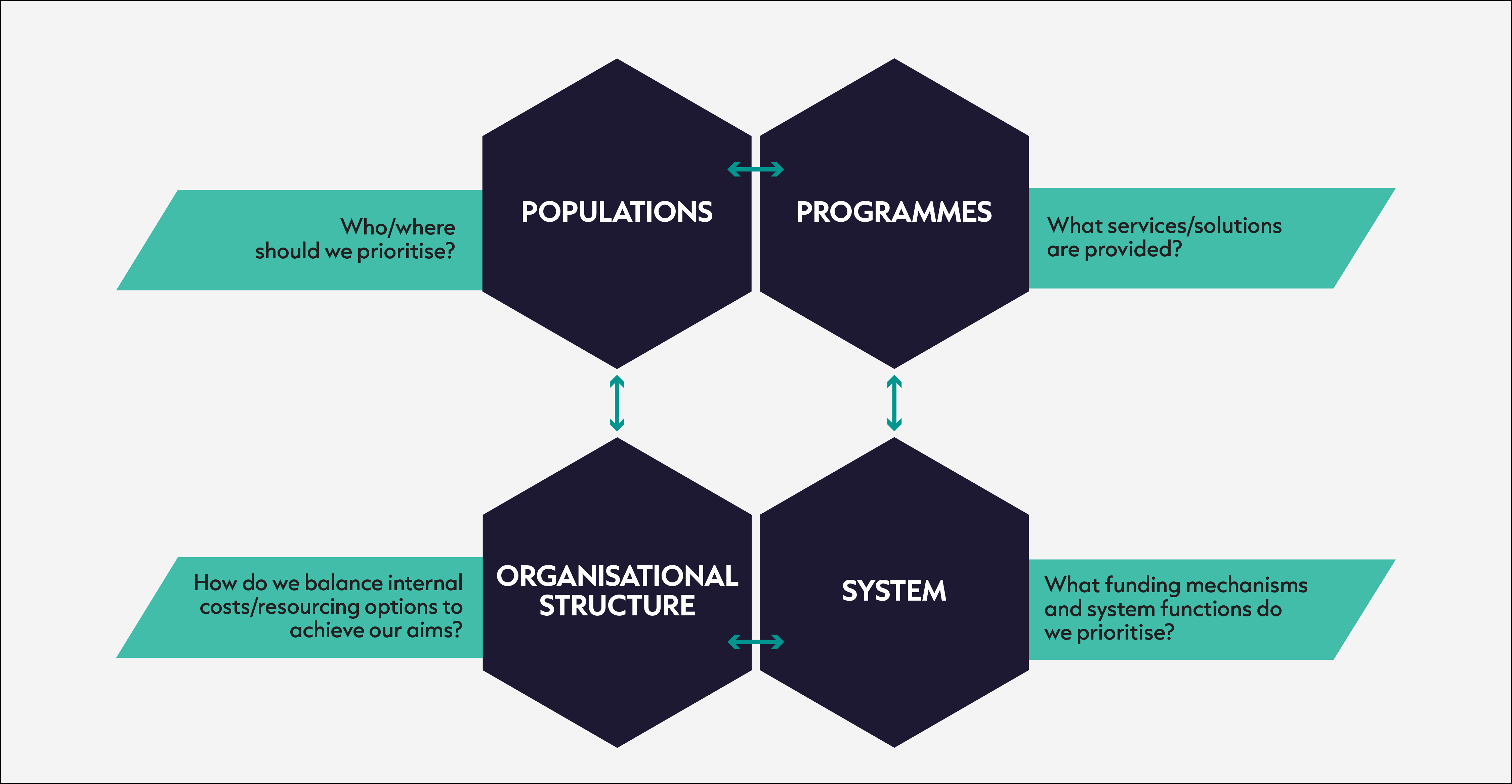
Humanitarians must make resource prioritisation choices across four areas – what we term ‘decision spaces’. These spaces are the populations, programmes, organisational structure and system – they concern the who, what and how of allocating resources.
Choices in one area have implications for choices in the others. For example, organisational choices around which specialisms to invest in will shape and will be shaped by what their programmatic offer is. Similarly, how the system is configured and what common data it uses will shape and will be shaped by which populations the system chooses to see.
1.2: Prioritising 'who' and 'what': Populations and programmes
When donors and agencies refer to allocating humanitarian resources to those ‘most in need’ or prioritising ‘life-saving’ objectives, this connects to decisions around populations and programmes. It involves choices about the ‘who’ and ‘what’ of humanitarian action: which populations, in which crises, receive what kind of support. There is a great deal of attention on these two areas of prioritisation because they relate to frontline dilemmas about people’s lives (Author, 2025). The first involves setting parameters for geographic targeting (the countries and locations to reach) and population targeting (the demographics or deprivation thresholds to focus on). The second involves decisions around which problems to address via programmatic selection and design (the services or goods to be prioritised and how these should be provided).
1.3: Prioritising 'how': Organisational structure and system
Humanitarian donors and agencies must also prioritise their resources internally, in terms of organisational and structural choices. This encompasses decisions on what functions are needed to run the organisation, with how many staff, and balancing resources allocated to direct services for populations affected by crisis versus quality, compliance or fundraising roles and functions at headquarters level. These resourcing decisions have significant downstream impacts on how humanitarian aid is delivered. For example, decisions made within agencies to cut gender specialists may impact gender-sensitive programming. With regard to donors, localisation advocates have long observed how staffing limitations underly a reliance on bulk granting to international intermediaries.
Finally, there are priorities to be decided at the system level – the core structures and roles that are needed to enable a well-functioning humanitarian ‘system’. This includes coordination, accountability and information management. Much of these prioritisation decisions are shaped by donors, through the ‘system enablers’ donors choose to fund (such as common risk and needs assessment tools, or coordination functions). They are also shaped by United Nations (UN) agencies, whose mandates enable them to determine the shape, size and structure of core functions (such as supply chain management, response coordination or transport logistics). A prioritisation approach to systems seeks to answer the question: Given resource constraints, what is the best architecture (functions, processes, mechanisms) to help us achieve our overall objectives/ goals?