A shrinking lens and a shrinking footprint
The funding cuts have drastically changed the coverage, presence and capabilities of humanitarian actors globally. Adjusting to the funding shock has cycled through three phases. The first, a disorderly contraction. The second, a planned reduction in the scope of what the system targets through the Humanitarian Reset process led by the Inter- Agency Standing Committee (IASC), which accelerated the ongoing process of redefining the scope and boundaries of UN-led response plans. And third, a longer-term adjustment to these two conditions, where humanitarian presence is concentrating and humanitarians are bracing for the consequences of focusing only on those in acute need.
In the immediate aftermath of the USAID ‘Stop Work’ order, organisations deployed whatever tactics they could to maintain programme presence. They triaged the most urgent work, seeking bridging grants and back-filling from internal resources as they awaited decisions amidst protracted uncertainty. Some USAID funding was later reinstated, though capabilities were often lost during the stop-work period. Country and field offices without funding prospects began to close and organisations reprioritised and restructured.
This represents a massive undocumented contraction of operational presence. UNHCR, for example, reduced its operational presence in around 185 locations, closing field units and offices and consolidating functions at capital level (UNHCR, 2025). OCHA in Colombia reportedly reduced its presence from 16 to just 4 sub-offices plus its capital office. INGOs described reducing their regional presence – consolidating services and functions in their headquarters, and closing field offices and some entire country programmes. LNAs are facing severe impacts. At least 120 member organisations of the Network for Empowered Aid Response (NEAR) reported office closures, staff layoffs or pay cuts, and it is likely that those most severely affected did not report their cuts.
The impacts of this rapid contraction in services are still largely undocumented. Humanitarian organisations described critical gaps in services. This includes vanishing treatment centres for moderate malnutrition, increasing the likelihood children will not receive treatment until they reach acute levels of malnutrition; the collapse of gender-based violence (GBV) referral pathways; the end of food security activities in highly food insecure areas, including in Cox’s Bazaar refugee camps; and cholera outbreaks in areas where water, sanitation and hygiene (WASH) programmes closed abruptly.
Let them (UN) do their thing, we’ll get on with ours. What has their prioritisation got to do with us?
Anonymous
The humanitarian scope of ambition contracted alongside its footprint. The collective prioritisation under the Humanitarian Reset included an announcement in March from the IASC Emergency Directors Group that eight countries – Cameroon, Colombia, Eritrea, Iraq, Libya, Nigeria, Pakistan and Zimbabwe – had been selected for an ‘accelerated transition’ out of the humanitarian coordination architecture.
This was followed by a global ‘hyper-prioritisation’ of the UN-led Humanitarian Needs and Response Plans (HNRPs), dramatically reducing the numbers of people targeted and funding requested. Of around 300 million people determined as being in need of humanitarian assistance at the beginning of 2025, the number targeted within the appeal was reduced from 181 million to just 116 million people. The GHO for 2026 further reduces the number of people in need of humanitarian assistance to 239 million. It notes, however, that the reduction reflects ‘more focused analysis, rather than a reduction in suffering’[1](OCHA, 2025b). The 2026 GHO also retains both the number of people ‘targeted’ and a much lower ‘hyper-prioritised’ target.
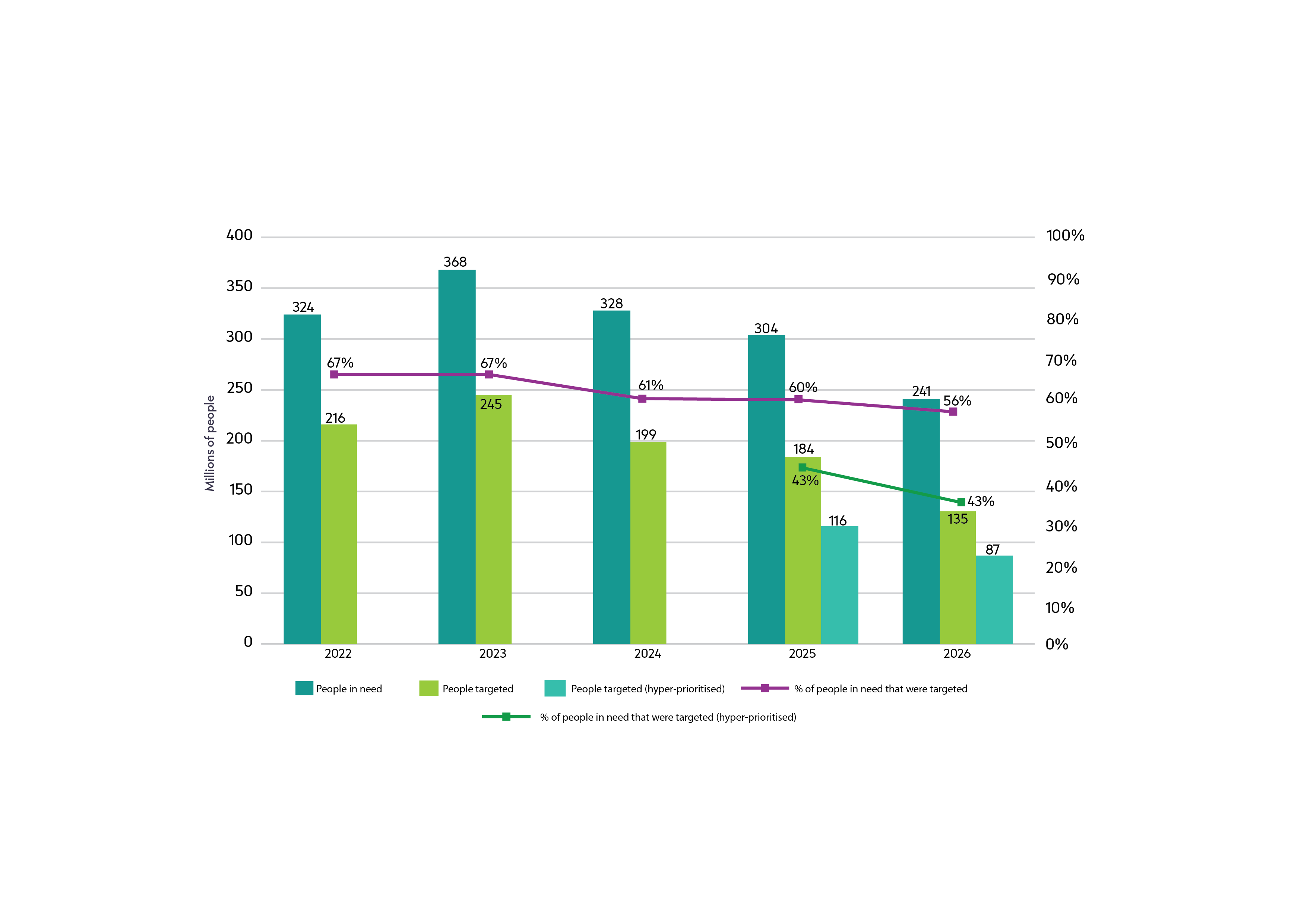
Even prior to the 2025 cuts, OCHA-led guidance for the HNRPs sought to tighten the scope of humanitarian needs. Emphasis on a specific set of core shocks and severity levels saw the numbers of people recognised as being in need of humanitarian response (People in Need – PiN) fall by 25% from the 2023 HNRPs to the 2025 plans. This proved controversial in principle and in practice. It was justified by those who argue the necessity of scaling back broad humanitarian ambition, which has extended into resilience, recovery and development-like service provision. And it was contested by those arguing the moral imperative for capturing the full extent of needs, unfiltered by funding feasibility.
As these scope questions took on renewed urgency in the context of the 2025 cuts, concerns intensified around how the system would count people in need. One interviewee told us: ‘the very least we owe affected people is to capture their needs and advocate for them’, while others voiced concerns that populations experiencing actual need are going unseen because they fall the wrong side of shock or severity thresholds.
The very least we owe affected people is to capture their needs and advocate for them.
Anonymous
Humanitarian organisations are now adjusting to the consequences of this dramatic narrowing in scope and targeting. One senior humanitarian in Somalia described in this new reality as the system prioritising resources for the ‘starving’ (IPC Phase 4/5) by taking resources from the ‘hungry’ (IPC Phase 3). They raised concerns that areas currently in IPC 3 will receive less assistance and become more likely to transition into IPC 4.
A feedback loop between presence and ambition looks to be taking root. The geographical focus is influencing where agencies retain operational presence – and operational presence and capacity is a factor in prioritising which populations will be targeted (OCHA, 2025c). So, as situations change, vulnerable populations in deprioritised areas are more likely to go uncounted and unassisted. Concerns were also raised that the designation of eight countries for ‘accelerated transition’ signals that donors are deprioritising these countries. While the rationale includes a transition to a nationally centred response, in practice the designation was reportedly imposed without consultation with country teams, and with no time and diminishing resources to put in place for such a transition.
UN agencies are openly fighting. What does prioritisation mean when UN agencies are in a open bid for survival?
LNA representative
Across ‘transition’ and HNRP countries, reduced humanitarian scope has been accompanied by expressions of hope that development actors will fill the vacuum. Yet this isn’t the case, by default or by design. Data shows that development finance has been in decline in protracted crises (ALNAP, 2025d). In Somalia, for example, OCHA reported in November that over 200 health facilities are now non-functional or closed and nutrition supplementary feeding sites have reduced from 617 to 300. This affects hundreds of thousands of people. It is the consequence of the closure of major development programmes on top of the humanitarian funding cuts (OCHA, 2025d).[2]
Footnotes
-
The methodological basis for this reduction is unclear. The GHO describes a ‘refined methodology that pinpoints where and who has been most affected by shocks – including conflict, climate and geological disasters, epidemics and animal and plant pests and diseases – and determines the most critical needs within these areas’. And it references the intersectoral severity as defined in the Joint and Intersectoral Analysis Framework (JIAF) (OCHA, 2025b).
-
This trend was already in train before the 2025 funding shock. Donnelly and Dhingra (2024) note, for example: ‘During a recent visit to Somalia, we heard how geographical prioritisation has meant that more stable areas have been deprioritised as part of the humanitarian response. But development donors have yet to fill the vacuum, meaning that hard-won gains in areas hosting thousands of IDPs and recovering from drought may be reversed.’