Organisational triage and the rolling toll of job cuts
The impact of the funding freeze was swift for organisations heavily exposed to US support and those lacking significant core funding and reserves. Organisations had to navigate liquidity shocks, drawing down reserves, the risks of incurring ineligible costs, legal risks of breaking labour and contract laws, and non-payment of suppliers. Many have also described the loss of trust and the breakdown of relationships with communities, local partners, governments and suppliers as projects abruptly ceased operating (ICVA, 2025a and 2025b).
Heavy job losses have been felt across all types of humanitarian organisation. Job losses publicly announced in 2025 by eight UN agencies, eight international non-governmental organisations (INGOs) and the International Committee of the Red Cross (ICRC) alone amount to more than 31,000 roles, with indications of more to come.
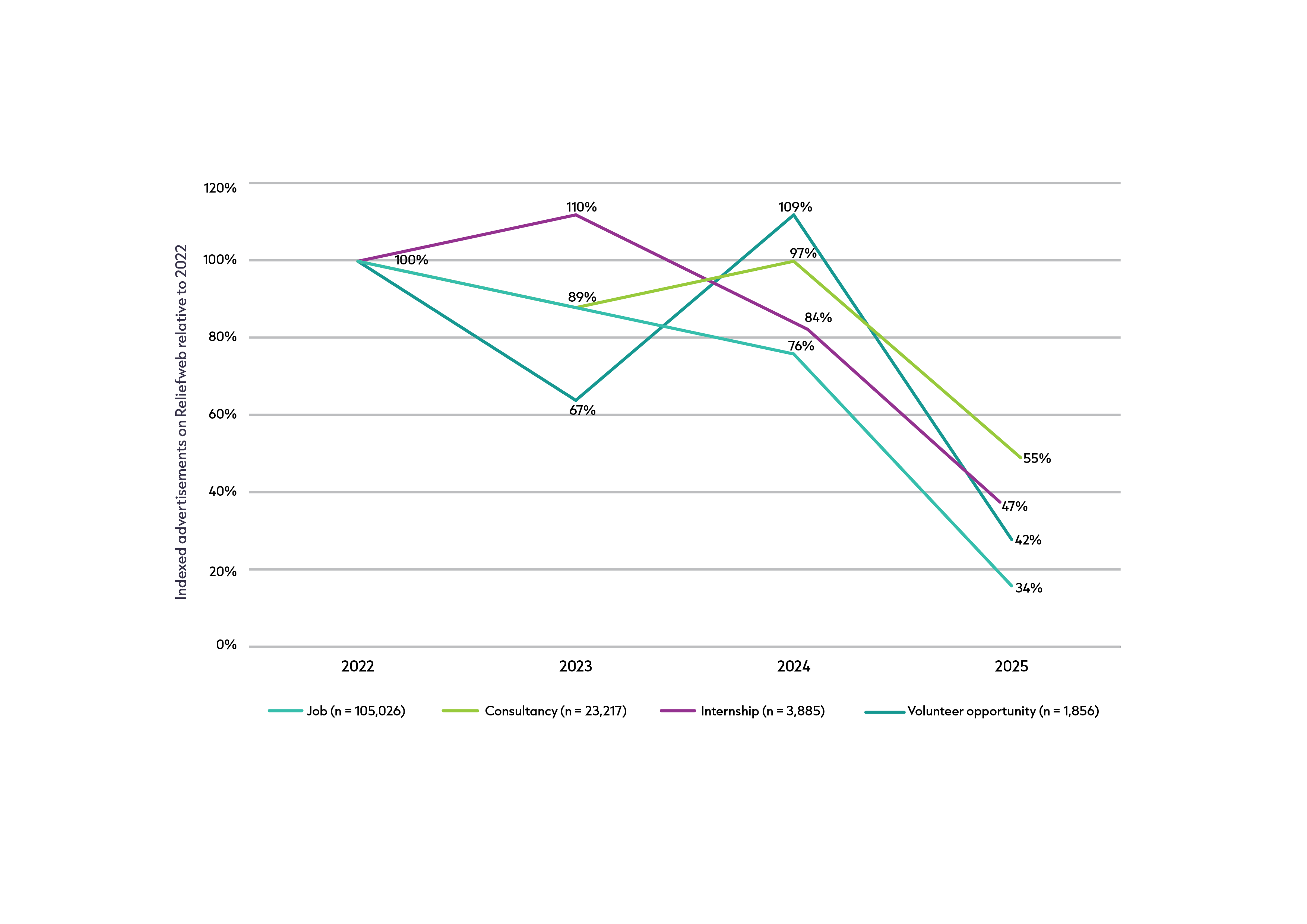
Similarly, new employment opportunities nose-dived in 2025, with postings of job vacancies halving across the sector compared with 2022 (Figure 3).
Local and national actors (LNAs), who typically have less core funding and lower reserves, were hit hard early in the year. In OCHA’s survey of the impacts of the aid freeze conducted in February 2025, LNA respondents reported the highest proportion of frozen funds (95% of 477 respondents), with 55% of LNAs reporting staffing cuts (compared with 45% of INGO and 37% of UN respondents) (OCHA, 2025a). A recent survey conducted by the Somali NGO Consortium (2025) among their members found that, by October, 75% of LNAs had closed field offices or project sites and 95% reported laying off staff. This compares with 47% of INGOs closing field offices and project sites and 68% implementing job cuts.
Some LNAs weathered the storm and maintained programming ‘accordion-like’ with low/ no pay – but they were left highly exposed to legal, financial and security risks. Only one third of LNAs in Somalia reported that they would be able to continue operating beyond the next six months without additional donor funding (ibid.).
Experiences of INGOs varied widely depending on their funding reliance on the US government and on their organisational reserves. Some had already undergone downsizings and restructurings in the previous two years, adjusting to falling revenues after the 2022/2023 funding peak. One INGO that had intentionally placed a cap on funding from single donors to reduce exposure had substantial reserves, enabling it to maintain staff and services throughout the period of uncertainty when US awards were under review. Others announced job cuts early, in the first weeks and months of 2025, but later revised these numbers as some USAID funding was reinstated. Although no two experiences seem to have been the same, many INGOs will end the year having passed through an unanticipated restructure and staff downsizing exercise.
It felt like country offices bared the brunt of the cuts, while SMT and senior leaders in global roles prioritised saving their positions.Where was the humanitarian mandate in this conversation? We didn’t know, because their decision-making process wasn’t shared in a transparent and logical manner.
INGO staffer
Sources suggest that national staff of international organisations were hit first as they were at the implementation end of US-funded programmes that were shut down. In the International Federation of Red Cross and Red Crescent Societies (IFRC), for example, national societies bore the first impact of staff cuts, with Secretariat-level cuts only being announced at the end of the year.
UN agencies reacted with job cuts later and were hit with a wider UN funding crisis as the year progressed. UN agencies announced and enacted job cuts later in 2025. The notable exception is the International Organisation for Migration (IOM), which is highly dependent on earmarked project funding and was heavily reliant on US funding. IOM announced substantial job cuts in March 2025.
The decision-making process was fully obscure in an effort to protect fixed term staff on the expense of consultants. Senior leadership refused to engage in an open conversation but rather used scare tactics to silence dissent.
UN regional staffer
The initial USAID funding shock to UN humanitarian operations was quickly leapfrogged by a much deeper funding crisis within the wider UN system. This was due to unpaid contributions to the UN’s regular budget. The UN80 reform process has devolved into an exercise in managing this budgetary crisis – negotiations with member states on next year’s budget are expected to run up to the wire on Christmas eve. Further substantial UN job cuts are expected next year, with the UN Secretary General announcing an 18.8% reduction in staffing (2,681 positions) in the 2026 budget as unpaid contributions rise to US$1.59 billion (Aljazeera, 2025).
The leaders of organisations have been criticised over the ways in which they have managed the crisis. Through our anonymous feedback platform we heard multiple complaints that management decisions were not consultative or transparent. In some cases, decisions prioritised protecting management positions and those on fixed-term contracts, over strategic considerations and maintaining service provision.
One INGO staffer told us, for example, that ‘It felt like country offices bared the brunt of the cuts, while SMT and senior leaders in global roles prioritised saving their positions. Where was the humanitarian mandate in this conversation? We didn’t know, because their decision-making process wasn’t shared in a transparent and logical manner.’ While a UN regional staffer felt that ‘the decision-making process was fully obscure in an effort to protect fixed term staff on the expense of consultants. Senior leadership refused to engage in an open conversation but rather used scare tactics to silence dissent.’ Others reported feeling jaded, burnt out and demoralised – echoing findings from Community World Service of remaining staff feeling ‘overburdened and morally conflicted’ (Nayanaran, 2025). Conversely, many respondents expressed that, on balance, their organisations did the best they could under the circumstances.[1]
Footnotes
-
Of 50 respondents, only 12 (24%) disagreed with the statement ‘The organisation did the best they could in the circumstances’.