Introduction

Aid cuts in 2025 shocked the humanitarian system and forced it into hyper-prioritisation mode. As the year draws to a close, we reflect on this annus horribilis – humanitarian funding plummeted to levels not seen for a decade, while the numbers of people forcibly displaced and facing food insecurity are more than double those of 2016. We look back at how this shock played out and what it means for the year and decade ahead (see Figure 1).

Our analysis – which is the fourth in ALNAP’s recent series exploring prioritisation (ALNAP, 2025a-c) – draws on several months of research, surveys and consultations with humanitarian organisations. It will also feed into the forthcoming edition of the State of the Humanitarian System (SOHS) report, due to be published in 2026. As evidence in Mali and South Sudan (ALNAP, 2025a) shows, the real costs of the funding cuts have been paid in human suffering: from shortages in food to increases in sexual violence. This paper complements that research by looking at the implications for humanitarian organisations, how they have navigated the system shocks and prioritisation choices, and what this meant for their ability to support people in crises.
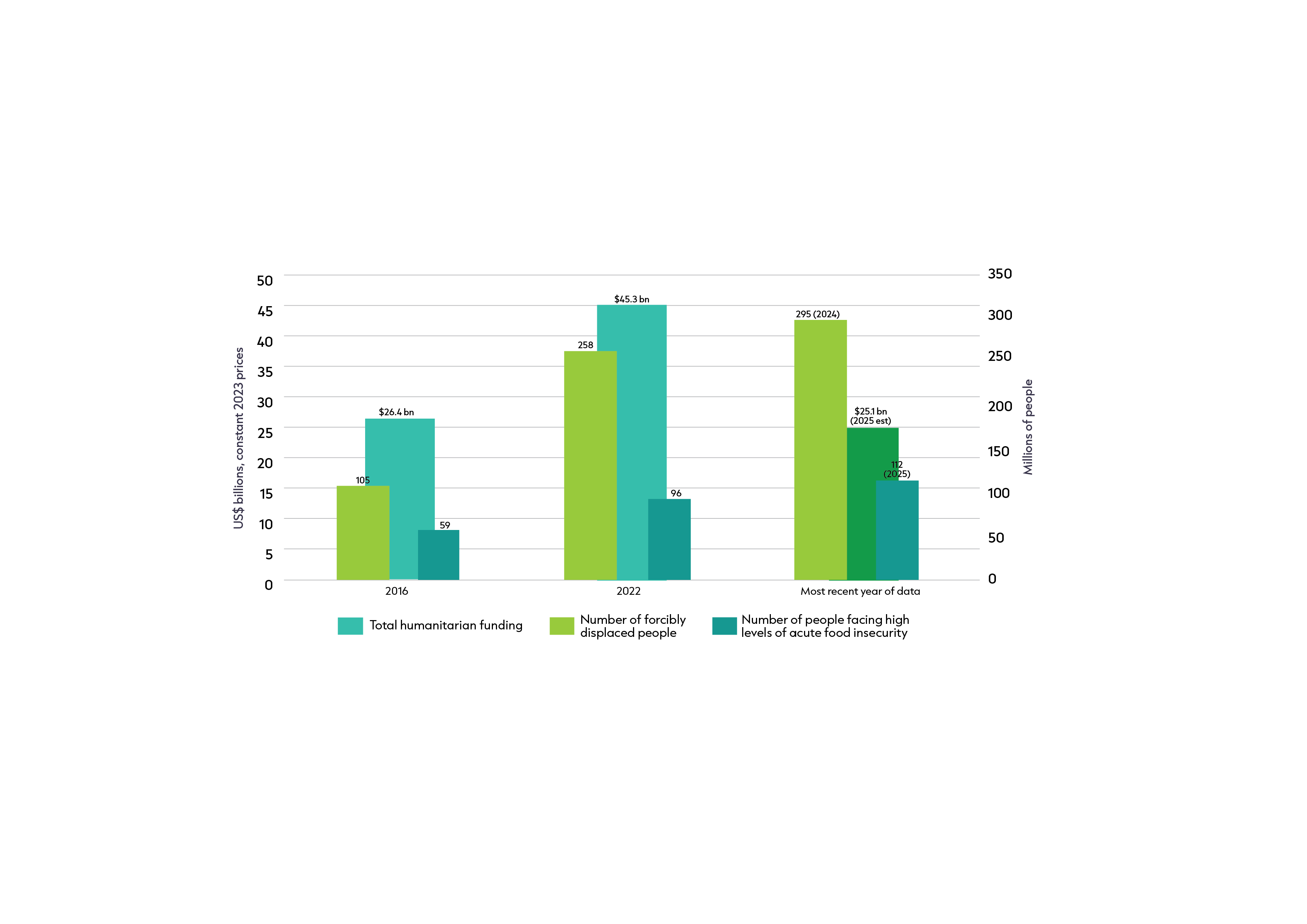
Figure 1: Numbers of people forcibly displaced and in high levels of food insecurity, and total humanitarian funding as reported to FTS 2016, 2022 and most recent year of available data

Source: United Nations High Commission for Refugees (UNHCR) Refugee Data Finder, Global Report on Food Crises (GRFC) database, UN Office for the Coordination of Humanitarian Affairs (OCHA) Financial Tracking Service (FTS) (accessed 9 December 2025), Development Assistance Committee of the Organisation for Economic Co-operation and Development (OECD DAC) and International Monetary Fund (IMF) World Economic Outlook for deflators.

Note: Numbers of forcibly displaced people include refugees, asylum seekers and internally displaced people (IDPs). The value for IDPs is based on data from the Internal Displacement Monitoring Centre (IDMC) in UNHCR’s database. Humanitarian funding data is the global total inside and outside of response plans as reported to FTS, deflated to constant 2023 prices using the average deflators across OECD DAC members. The 2025 value for the volumes of total humanitarian funding is shaded differently, given it is estimated based on the average growth over 2022–2024 of funding inside and outside of response plans as reported to FTS between the end of November and the final annual figures. An actual or projected 2025 value for the number of people facing high levels of acute food insecurity (IPC Phase 3 and above) is not yet available.When multiple sectors are c, the funds are categorised as multisectoral, as the data does not allow further disaggregation of each grant by the share contributed to different sectors. The current estimate focuses on US.