The funding story of 2025
Many crises and humanitarian partners entered 2025 already in downsizing mode. Humanitarian funding was trending downwards from a historic high in 2022, with a sharp 10% contraction in 2024 (ALNAP, 2025d). This was, in part, a return to regular spending levels following a COVID-19 funding spike and responses to major crises such as a scale-up to avert famine in Somalia. But some key donors had also begun signalling longer-term political commitments to reduce and re-prioritise their aid budgets. For many crises, shortfalls had become entrenched as high profile crises – Ukraine, in particular – attracted a disproportionate share of humanitarian funds.
The ‘Stop Work’ order in the US in January 2025 and ultimate rescission of swathes of US aid were largely unanticipated and extremely damaging. The US government’s abrupt 90-day pause, issued on 20 January 2025 while it reviewed ‘programmatic efficiency and consistency with United States foreign policy’, led to immediate and widespread disruption (White House, 2025). In the wake of this decision, humanitarian organisations reported a turbulent funding year. They had little to no clarity on whether they would be reimbursed for funds already spent, and if or when committed US funds would resume, particularly in the first quarter of 2025.
A huge rupture in trust
Anonymous
Some funding from USAID was later reinstated, but it is only becoming visible now which countries, sectors and partners were spared. Funding coverage for some crises is very low indeed. Unexpectedly, some countries – notably Sudan, South Sudan, Ethiopia, Bangladesh and Burkina Faso – will still close the year with the US as their leading donor.[1]Periods of frozen USAID activities, where funds were later reinstated, mean that some organisations have underspends and no-cost extensions that will carry over to the first quarter of next year. There is very little clarity on future funding priorities and prospects for US funding beyond this at present.
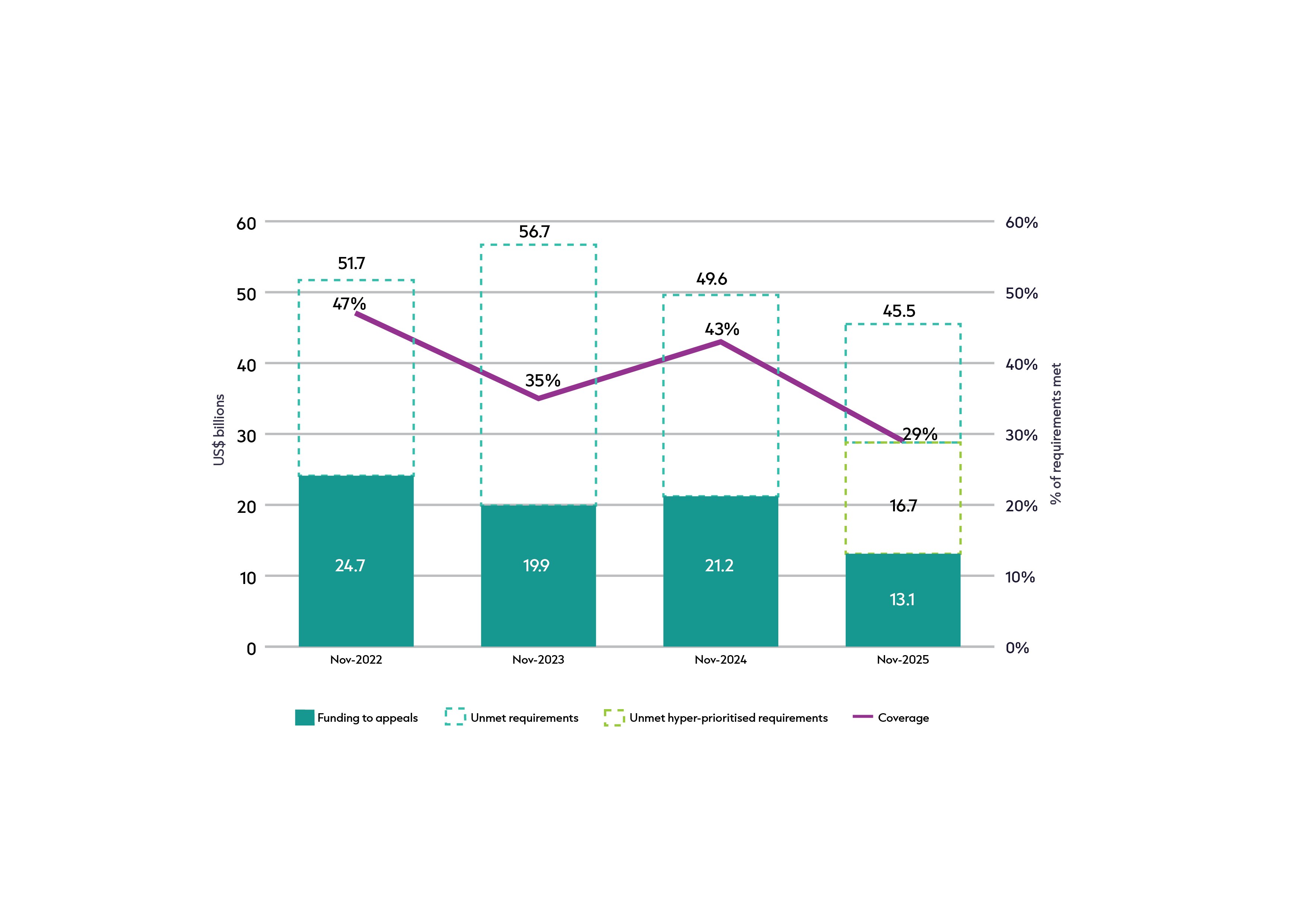
Currently, the UN coordinated response plans look set to close the year with less than half the funds received in 2022 (see Figure 2). Adjusted for inflation, this funding level is similar to that achieved in 2016 (US$14.5 billion) – when the international humanitarian system and its ambitions were considerably smaller.[2]
Footnotes
-
This funding was heavily concentrated and these five countries received 78% of the US government’s country allocable humanitarian funding in 2025.
-
See OCHA (n.d.). Figures are adjusted for inflation using the average deflator for OECD DAC countries in 2023 prices. The amount of funding to appeals in 2016 in current prices was US$12.5 billion.